
Soft Starters vs VFDs – Which Is Better for Your Application?
When it comes to controlling electric motors, two of the most popular technologies are the soft starter and the variable frequency drive (VFD). Both help reduce mechanical stress and inrush current during motor starting, but they work in different ways and are suited to different applications. Choosing the right solution can save energy, protect equipment, and reduce operating costs.
In this in-depth guide, we’ll break down the key differences between soft starters and VFDs, explain how each works, explore their advantages, and help you decide which technology best fits your system. We’ll also link to free tools like our VFD Sizing Calculator and Motor Starter Selection Calculator to make your selection process easier.
What Is a Soft Starter?
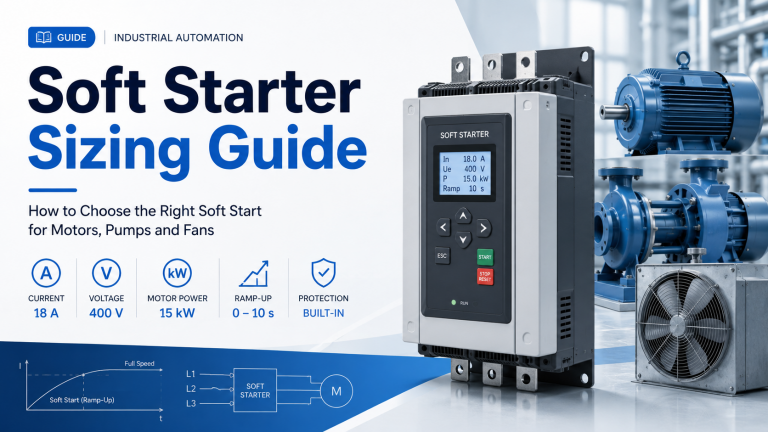
A soft starter is an electronic device designed to gradually ramp up the voltage supplied to an AC motor during startup. By controlling voltage rather than frequency, a soft starter limits the inrush current and torque shock associated with direct-on-line (DOL) starting.
How It Works
Soft starters use silicon-controlled rectifiers (SCRs) arranged in pairs to control the voltage applied to each phase. During startup, the SCRs progressively increase the conduction angle, ramping voltage smoothly from zero to full supply level. Once the motor reaches rated speed, the SCRs bypass via internal contactors, allowing full voltage operation with minimal losses.
Key Benefits
- ⚙️ Reduced mechanical stress on couplings, belts, and gearboxes
- ⚙️ Lower inrush current — prevents voltage dips and nuisance trips
- ⚙️ Compact, cost-effective solution for simple fixed-speed motors
- ⚙️ Easy installation and setup — typically only a few parameters
What Is a Variable Frequency Drive (VFD)?
A VFD, also known as an inverter drive, adjusts both the voltage and frequency of power supplied to an AC motor. This allows full control over motor speed, torque, and direction — not just during startup, but throughout operation.
How It Works
A VFD converts incoming AC power to DC via a rectifier, then reconstructs a variable-frequency AC output through an inverter stage using pulse-width modulation (PWM). By varying frequency, the motor’s speed can be precisely controlled, enabling dynamic acceleration, deceleration, and energy optimisation.
Key Benefits
- ⚙️ Full speed control from 0 Hz to rated frequency
- ⚙️ Significant energy savings for variable torque loads (fans/pumps)
- ⚙️ Built-in protections: overload, overvoltage, and motor temperature monitoring
- ⚙️ Compatibility with communication networks (Modbus, Ethernet/IP, Profibus)
- ⚙️ Programmable acceleration/deceleration ramps for smooth operation
Soft Starter vs VFD – The Core Differences
Although both technologies manage motor starting current, they serve different purposes. The table below summarises the major distinctions:
| Feature | Soft Starter | VFD (Inverter Drive) |
|---|---|---|
| Function | Reduces voltage during start | Controls voltage & frequency for full speed regulation |
| Speed Control | No | Yes, variable speed across full range |
| Energy Savings | Limited to reduced start losses | High — especially for centrifugal loads |
| Torque Control | Basic, voltage-based | Precise, vector or torque-controlled |
| Braking Options | Optional DC injection | Dynamic braking and regeneration possible |
| Cost | Lower | Higher upfront, lower operating cost |
| Maintenance | Minimal | Requires regular filter/fan maintenance |
When to Use a Soft Starter
Soft starters are ideal when:
- ✅ You only need smooth motor acceleration and deceleration
- ✅ The motor operates at fixed speed
- ✅ Energy savings from speed control are minimal
- ✅ You want a cost-effective and compact solution
Common applications:
- 🏭 Conveyors and belt drives
- 🚰 Centrifugal pumps with fixed speed
- 🌀 Fans and blowers with simple on/off operation
- ⚙️ Compressors and crushers
When to Use a VFD
A VFD is the right choice when you need dynamic speed or torque control, advanced protection, or energy savings through variable operation.
- ✅ Applications require frequent starts/stops or varying speed
- ✅ Energy efficiency is a priority (HVAC, pumping, and ventilation)
- ✅ Process control requires PID regulation or torque limiting
- ✅ You want remote monitoring or PLC communication integration
Common applications:
- 🚿 Variable-flow pumps (energy savings up to 50%)
- 🪫 HVAC fans and chillers
- 🏗️ Hoists, cranes, conveyors with torque ramping
- 🧵 Mixers, extruders, and process lines
Energy Efficiency Comparison
The major advantage of VFDs is energy efficiency. For centrifugal loads, torque varies with the square of speed, and power varies with the cube. That means even a small reduction in speed drastically reduces power consumption. A 20% reduction in speed can cut energy use by almost 50%.
Soft starters, by contrast, only reduce power during startup. Once at full speed, they run at line voltage, offering no further energy savings.
System Protection & Monitoring
Both technologies protect your motor, but VFDs offer deeper diagnostics and fault handling. A typical ABB ACS355 or Allen Bradley PowerFlex 525 continuously monitors current, voltage, and temperature, issuing detailed fault codes to your PLC or HMI.
Soft starters like the ABB PSR series or Danfoss MCD series provide basic trip indicators for overload or phase imbalance but lack advanced diagnostics.
Installation & EMC Considerations
Soft starters are simpler to install — they require fewer connections and generate less electromagnetic noise. VFDs, however, require more attention to EMC compliance due to high-frequency PWM switching. For guidance, see our post on VFD EMC Compliance and use our Cable Sizing Calculator to select appropriate shielded cables.
Cost Comparison
Soft starters typically cost 30–60% less than an equivalent-rated VFD. However, when energy savings and process control are factored in, a VFD’s total cost of ownership can be lower over time. For fixed-speed systems, a soft starter remains the most economical choice.
Practical Example – Pump Station Upgrade
Consider a 15 kW pump that operates 24 hours per day at variable flow. Replacing a DOL starter with a soft starter will reduce startup stress but provide no energy reduction. Using a Danfoss VLT Micro Drive FC-51 or Delta VFD-E Series inverter, the motor speed can adjust to flow demand — often cutting power use by 20–50% annually, with payback in less than a year.
Torque Control and Smooth Operation
Soft starters offer limited torque control; once bypassed, torque is fixed. VFDs provide continuous torque regulation, allowing constant-torque applications such as conveyors or extruders to run smoothly across the speed range. Advanced vector-controlled drives like the Omron 3G3MX2 or ABB ACS355 deliver precise torque even at low speeds.
Braking and Regenerative Capabilities
Soft starters usually offer only DC injection braking. VFDs, however, can handle dynamic braking or energy regeneration through a braking resistor or feedback unit. Use our Braking Resistor Calculator to size braking components for controlled deceleration in heavy-duty applications.
Integration with PLCs and HMIs
For automated systems, VFDs are far superior. They integrate directly with PLCs and HMIs using industrial protocols. For example, an Allen Bradley PanelView Plus 7 or Delta DOP-107BV HMI can display drive speed, torque, and fault data in real time. Soft starters lack communication interfaces, limiting visibility and control.
Maintenance and Reliability
Soft starters require minimal maintenance as they only engage during startup. VFDs, while offering more functionality, include fans and capacitors that need periodic inspection and replacement (every 3–5 years). Still, modern VFDs like the ABB ACS355 and Allen Bradley PowerFlex 523 are designed for long-term reliability with MTBF ratings above 250,000 hours.
Environmental and Space Considerations
Soft starters have a smaller footprint and generate less heat, making them suitable for tight enclosures. VFDs, by contrast, require adequate cooling and airflow. When panel space or ambient temperature is a constraint, a compact soft starter such as the ABB PSR range is often the better choice.
Summary: Soft Starter vs VFD – Quick Reference
- 🧰 Use a Soft Starter for simple fixed-speed applications needing gentle starts.
- ⚡ Use a VFD when variable speed, energy savings, or torque control are required.
- 💰 Soft Starter = Lower upfront cost | VFD = Lower lifecycle cost.
- 🔧 Soft Starter = Simple installation | VFD = Advanced integration.
Conclusion: Choosing the Right Solution for Your Motor
Both soft starters and VFDs play vital roles in motor control. Your choice depends on whether your application requires only smooth starting or full-range speed and torque control. For fixed-speed motors, a soft starter offers simplicity and value. For dynamic, energy-sensitive systems, a VFD is the smarter investment.
Before you buy, check your motor’s load profile, starting current, and duty cycle using our free engineering tools:
- ⚙️ VFD Sizing Calculator
- ⚙️ Motor Starter Selection Calculator
- ⚙️ VFD Cable Sizing Calculator
- ⚙️ Braking Resistor Calculator
Once you’ve identified the right solution, explore our wide range of VFDs and soft starters from ABB, Allen Bradley, Danfoss, Delta, and Omron — all available from stock with fast UK delivery and unbeatable pricing.
At Drive Outlet Megastore, we help engineers and OEMs choose the right motor control technology for every application. Contact our expert team for professional guidance and same-day quotations.