
What Is Motor Slip and How Does It Affect VFD Performance?
When discussing AC motors and variable frequency drives (VFDs), one term you’ll often hear is “slip.” Slip is a critical concept that defines the difference between a motor’s synchronous speed and its actual running speed. Understanding how slip works—and how it interacts with your VFD—is key to achieving accurate speed control, high efficiency, and reliable torque performance in your system.
In this guide, we’ll break down what motor slip is, why it happens, and how modern inverter drives manage it to deliver precise motor control. We’ll also link to practical tools like our VFD Sizing Calculator and Cable Sizing Calculator to help you design a system that performs flawlessly.
⚙️ What Is Motor Slip?
In a standard AC induction motor, the stator creates a rotating magnetic field at a speed called the synchronous speed. The rotor follows this field, but it can never spin quite as fast — this difference in speed is known as slip.
Slip (%) = ((Synchronous Speed − Rotor Speed) ÷ Synchronous Speed) × 100
For example, if a 4-pole motor runs from a 50 Hz supply, its synchronous speed is 1500 RPM. If the motor shaft actually spins at 1470 RPM under load, the slip is:
((1500 – 1470) ÷ 1500) × 100 = 2 %
That 2 % difference allows the rotor to develop torque — without slip, the motor couldn’t generate any usable shaft power.
🔍 Why Slip Happens in Induction Motors
Slip occurs due to the physics of induction. The stator’s rotating field induces current in the rotor bars, which in turn create a secondary magnetic field. The difference in speed between the stator field and the rotor field (the slip) is what produces torque.
The higher the mechanical load, the more slip is required to generate sufficient torque. This is why motors slow slightly under load — they “slip” more to increase current and torque output.
⚡ Slip and Torque Relationship
Slip and torque are directly linked. As load increases, slip rises, causing more rotor current and torque production—up to the motor’s breakdown torque limit.
- 🟢 Low Slip (1–2%): Normal under light loads, minimal losses, high efficiency.
- 🟡 Medium Slip (3–5%): Moderate load; torque and current increase.
- 🔴 High Slip (>6%): Overload condition; excessive current and heat build-up.
At high slip values, efficiency drops and rotor heating becomes significant, which can shorten motor life if sustained for long periods.
🎛 How VFDs Control Slip
VFDs control slip by precisely adjusting the frequency and voltage supplied to the motor. By managing the stator field speed, they can minimise slip while maintaining required torque.
- ⚙️ In V/f Control, the VFD maintains a constant voltage-to-frequency ratio to ensure consistent torque and moderate slip.
- 🧠 In Vector Control or Field-Oriented Control, the VFD continuously monitors current feedback to estimate torque and actively compensate for slip.
This means modern inverter drives can hold motor speed extremely close to the commanded value — often within 0.1 % accuracy, even under varying loads.
📈 How Slip Affects VFD Performance
Slip impacts key performance parameters such as torque stability, efficiency, and thermal loading. Understanding this helps in proper VFD selection and tuning.
- 1️⃣ Speed Accuracy: Too much slip leads to underspeed. Vector control VFDs correct this automatically.
- 2️⃣ Torque Response: Proper slip ensures steady torque production without oscillation or hunting.
- 3️⃣ Efficiency: Lower slip means reduced losses and better overall energy efficiency.
- 4️⃣ Motor Heating: High slip increases rotor current, raising temperature. VFDs mitigate this via current limit and torque control.
When properly tuned, a VFD can reduce slip losses by up to 30 % compared to direct-on-line operation.
🧮 How to Calculate Motor Slip with a VFD
Because a VFD changes frequency, synchronous speed changes too. Use this equation:
Synchronous Speed = (120 × Frequency) / Number of Poles
Example: A 4-pole motor at 45 Hz → 1350 RPM synchronous speed. If the measured rotor speed is 1320 RPM, slip = (1350 – 1320)/1350 = 2.2 %.
You can experiment with different load conditions using our VFD Sizing Calculator and Braking Resistor Calculator to see how slip and torque interact at varying speeds.
🏭 Real-World Example: Slip in Heavy-Duty Applications
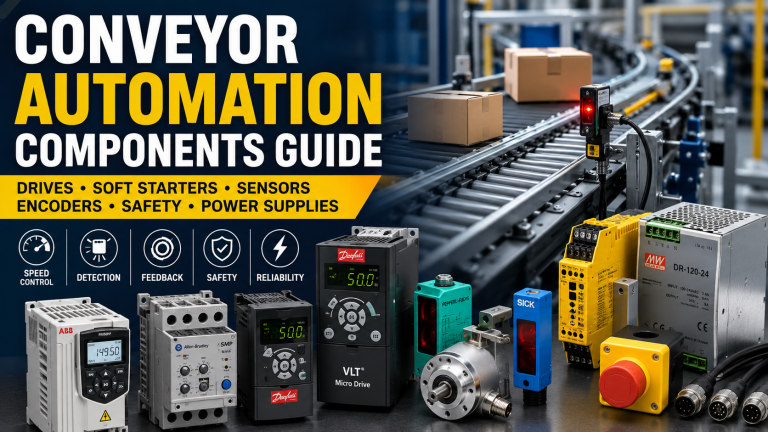
Consider a Siemens SINAMICS G120C running a compressor. Under full load, slip increases to maintain torque. The VFD dynamically adjusts voltage and current to prevent stalling. Meanwhile, an Allen Bradley PowerFlex 525 controlling a conveyor compensates slip instantly using vector control — maintaining constant speed even when material weight varies.
Slip control is equally vital in mixing and pumping systems, where torque fluctuations can affect process quality. Drives like the Danfoss FC-051 Micro Drive and ABB ACS355 handle this gracefully with precise current feedback and automatic torque boost.
🔧 Reducing Slip-Related Losses
To keep slip under control and maximise system performance, follow these best practices:
- ✅ Select a VFD rated for constant torque duty where required.
- ✅ Match motor and VFD parameters (voltage, current, poles, frequency) accurately.
- ✅ Enable vector or sensorless vector control in the drive configuration.
- ✅ Use correctly sized cables via our Cable Sizing Calculator to minimise voltage drop.
- ✅ Regularly check motor bearings and ventilation to prevent overheating from high slip.
📊 Typical Slip Ranges by Load Type
| Load Type | Typical Slip (%) | Recommended Drive Type |
|---|---|---|
| Fans / Pumps (Variable Torque) | 1–2 % | V/f Control |
| Conveyors / Mixers (Constant Torque) | 2–4 % | Vector Control |
| Compressors / Crushers | 3–6 % | Sensorless Vector or Closed Loop |
🧠 Summary: Why Slip Matters
- Slip is the speed difference between stator and rotor that allows torque generation.
- Excessive slip means wasted energy and higher heat losses.
- Modern VFDs dynamically manage slip for precise torque and speed regulation.
- Understanding slip helps optimise drive settings and improve motor lifespan.
Conclusion
Slip is a natural and necessary part of induction motor operation — but with a properly configured VFD, you can control it for better efficiency, accuracy, and reliability. By matching the drive’s frequency to your process and fine-tuning torque control, slip becomes a performance advantage instead of a limitation.
Start optimising your setup today using our engineering tools:
- VFD Sizing Calculator
- Cable Sizing Calculator
- Braking Resistor Calculator
- Motor Starter Selection Calculator
At Drive Outlet Megastore, we supply genuine ABB, Siemens, Danfoss, and Allen Bradley inverter drives — all designed to deliver precise slip control, maximum efficiency, and long-term reliability. Contact our team for expert help in selecting the perfect drive for your application.