
What Happens When You Oversize or Undersize a VFD? Real-World Effects Explained
Choosing the wrong VFD size is one of the fastest ways to cause poor performance, nuisance trips, wasted energy, or early drive failure.
Many people assume “bigger is safer” — while others try to save money by undersizing. Both approaches can cause serious problems.
This guide explains exactly what happens when a VFD is oversized or undersized, how it affects motors and drives in real applications, and how to size a VFD correctly the first time.
Quick Links
- Why VFD sizing matters
- What happens when a VFD is undersized
- What happens when a VFD is oversized
- Why current matters more than kW
- Load type: constant vs variable torque
- Real-world sizing examples
- How to size a VFD correctly
- Free sizing tools
- Recommended drive categories
- FAQ
Why VFD Sizing Matters More Than Most People Think
A VFD must be matched to motor current, load type, duty cycle, and environment — not just motor power.
Incorrect sizing causes:
- Nuisance overcurrent or thermal trips
- Weak torque or unstable speed
- Overheating of motors or drives
- Reduced efficiency and higher running costs
- Premature failure of power electronics
Many of these issues are also covered in: VFD Installation Mistakes That Cause Drive Failures
What Happens When a VFD Is Undersized
An undersized VFD simply cannot supply the current the motor demands under load.
Common symptoms
- Overcurrent trips during acceleration
- Frequent fault codes under normal load
- Motor struggling to start or stalling
- Excessive motor heating
Why this damages equipment
- Drive components run at or above limits
- Thermal stress shortens capacitor life
- Repeated trips indicate sustained overload
Undersizing is especially common on:
- High-inertia loads
- High starting torque applications
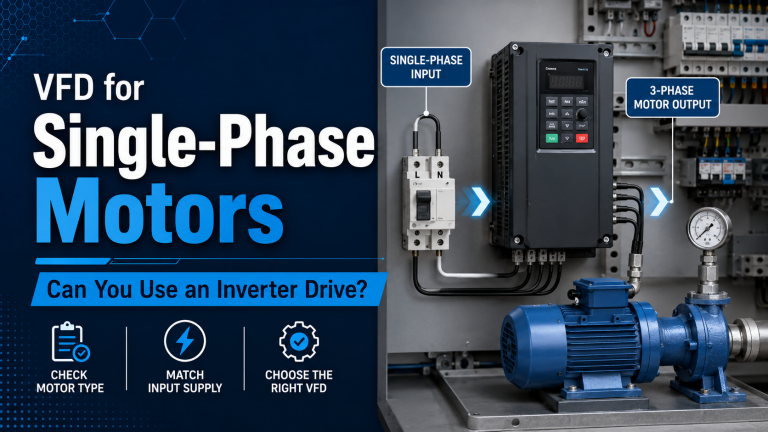
- Single-phase input drives running three-phase motors
What Happens When a VFD Is Oversized
Oversizing a VFD doesn’t usually cause immediate faults — but it creates subtle long-term problems.
Common issues
- Poor current resolution at low loads
- Reduced motor protection accuracy
- Lower efficiency at partial load
- Unnecessary capital cost
Why “bigger isn’t better”
- Motor protection functions rely on accurate current measurement
- Oversized drives may not protect smaller motors correctly
- Low-load operation reduces efficiency
Oversizing is often used to “solve” problems that are actually caused by incorrect control mode or braking setup.
See: VFD Control Modes Explained
Why Current Matters More Than kW
Two motors with the same kW rating can have very different full-load currents.
VFDs are fundamentally current-limited devices.
Always size based on:
- Motor full-load current (FLA)
- Supply voltage and phase
- Duty cycle and overload requirement
Motor nameplate data is critical: How to Read a VFD Nameplate
Load Type: Constant Torque vs Variable Torque
Variable torque loads
- Fans
- Pumps
- Blowers
These typically allow smaller drives because torque demand drops with speed.
Constant torque loads
- Conveyors
- Mixers
- Extruders
These require full torque at low speed — often demanding a larger drive or vector control.
Related guide: VFDs for High-Torque Loads – Crushers, Mixers & Compressors
Real-World Sizing Examples
Example 1: Conveyor system
A 5.5kW motor draws high starting current. A 5.5kW VFD trips on acceleration.
Fix: Upsize to the next frame or select a vector-rated drive with higher overload capability.
Example 2: Fan application
A 7.5kW drive runs a lightly loaded fan at 40% speed.
Issue: Oversized drive runs inefficiently with poor motor protection.
Fix: Select a drive matched to actual current and load.
How to Size a VFD Correctly
- Read the motor nameplate carefully
- Identify load type and starting requirements
- Check supply voltage and phase
- Account for environment (temperature, altitude, enclosure)
- Verify braking and deceleration requirements
Full guide: How to Size a VFD Correctly for Motor Power and Load Type
Free VFD Sizing Tools
Recommended VFD Categories
Example Drives
- ABB ACS355 – strong overload capability: ABB ACS355-03E-04A1-4
- Allen Bradley PowerFlex 525 – versatile sizing range: Allen Bradley 25B-D017N114
FAQ
Is it safer to oversize a VFD?
No. Oversizing causes poor motor protection and wasted energy.
Can undersizing damage a motor?
Yes. Frequent trips and overheating stress both motor and drive.
Should I size based on kW or amps?
Always size based on motor current and application duty.
Need Help Sizing a VFD?
If you want to avoid oversizing or undersizing, send us your motor nameplate and application details.
Contact us: https://driveoutletmegastore.com/contact-us/