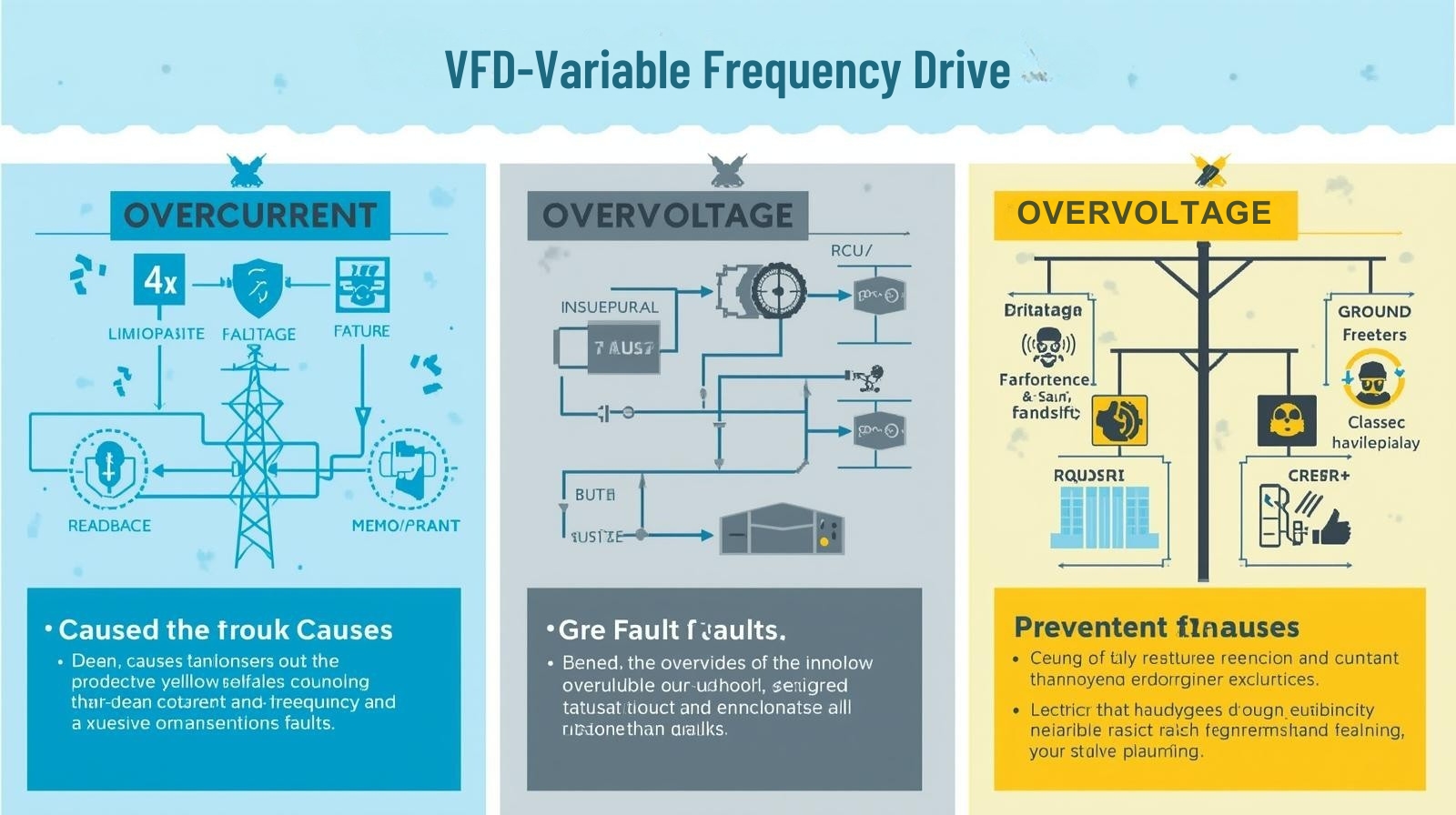
VFD Overcurrent, Overvoltage & Ground Faults Explained – Causes and Prevention
Variable Frequency Drives (VFDs) are highly reliable when installed and configured correctly. However, three of the most common faults users encounter are overcurrent, overvoltage, and ground fault trips.
These faults are often misunderstood and frequently misdiagnosed, leading to unnecessary drive replacements or repeat failures. In this guide, we explain what each fault means, the most common causes, and how to prevent them in real-world applications.
What Is a VFD Fault?
A VFD fault occurs when the drive detects an electrical or mechanical condition that could cause damage to the motor, drive, or system. To protect itself, the VFD shuts down and displays a fault code.
Understanding why the fault occurred is critical before resetting or replacing the drive.
VFD Overcurrent Faults Explained
An overcurrent fault occurs when the motor draws more current than the VFD is rated to supply.
Common Causes of Overcurrent Faults
- Motor overload or mechanical jam
- Incorrect VFD sizing
- High starting torque demand
- Short acceleration time
- Incorrect motor parameters
- Worn bearings or gearbox issues
Overcurrent faults are especially common in constant torque applications such as conveyors, mixers, and extruders.
How to Prevent Overcurrent Faults
- Select a VFD rated for constant torque or heavy duty
- Increase acceleration time
- Verify motor nameplate settings
- Check for mechanical binding
- Use a gearbox to reduce torque demand
VFD Overvoltage Faults Explained
An overvoltage fault occurs when the DC bus voltage inside the VFD exceeds safe limits. This most commonly happens during deceleration.
Common Causes of Overvoltage Faults
- Rapid deceleration of high inertia loads
- Regenerative energy from the motor
- High incoming supply voltage
- Incorrect braking settings
Applications with large rotating masses such as fans, centrifuges, and conveyors are especially prone to overvoltage faults.
How to Prevent Overvoltage Faults
- Increase deceleration time
- Enable DC braking where appropriate
- Install a braking resistor or braking unit
- Check supply voltage stability
In high-inertia applications, fitting a braking resistor is often the most reliable solution.
VFD Ground Faults Explained
A ground fault occurs when current leaks from the motor phase conductors to earth. VFDs are extremely sensitive to ground faults to protect against electrical hazards.
Common Causes of Ground Faults
- Damaged motor cables
- Moisture ingress in motors
- Incorrect cable termination
- Insulation breakdown
- Long motor cable runs
Ground faults are often intermittent and may only appear when the motor heats up or operates at higher speed.
How to Prevent Ground Faults
- Use correctly rated screened motor cables
- Ensure proper earthing practices
- Check insulation resistance regularly
- Use inverter-rated electric motors
The Role of Motor Cables and EMC
Poor cabling practices are a major contributor to VFD faults.
- Long cable runs increase leakage currents
- Unsuitable cable types increase electrical noise
- Poor grounding leads to nuisance trips
For longer motor cable runs, output filters and proper EMC practices are essential.
Mechanical Issues That Cause Electrical Faults
Not all VFD faults are electrical in origin. Mechanical problems often trigger electrical protection.
- Seized bearings
- Misaligned couplings
- Overloaded conveyors
- Failing gearboxes
Always inspect the mechanical system before assuming the VFD is faulty.
Common Mistakes When Troubleshooting VFD Faults
- Resetting faults without investigation
- Replacing the VFD without checking the motor
- Ignoring acceleration and deceleration settings
- Oversizing motors instead of fixing the root cause
Frequently Asked Questions
Can a VFD be damaged by repeated faults?
Yes. Frequent overcurrent or overvoltage events can shorten drive lifespan.
Do ground faults always mean the motor is faulty?
No. Cables and terminations are often the cause.
Should I oversize a VFD to avoid faults?
Moderate oversizing helps, but it is not a substitute for correct system design.
Why does my VFD trip during deceleration?
This is usually caused by regenerative energy raising the DC bus voltage.
Can a gearbox help reduce VFD faults?
Yes. Gearboxes reduce torque demand and regenerative stress.
Need Help Fixing VFD Faults?
At Drive Outlet Megastore, we supply industrial-grade inverter drives, electric motors, gearboxes, and drive accessories for reliable operation.
If you are experiencing repeated VFD faults or need help selecting the correct drive for your application, contact our team and we’ll help you solve the problem properly — not just reset it.