
VFD Output Filters Explained – dV/dt vs Sine Wave Filters
VFD output filters play an important role in protecting motors, reducing electrical stress, and improving reliability in variable frequency drive installations. When a motor is powered by an inverter drive, the output waveform is not a smooth sine wave like the mains supply. Instead, the drive generates a high-speed pulse width modulated waveform, and that can create problems in some applications.
This is where output filters come in. Two of the most common types are dV/dt filters and sine wave filters. While both are used on the output side of a VFD, they solve slightly different problems and are suited to different installation conditions.
In this guide, we explain what VFD output filters do, the difference between dV/dt and sine wave filters, when each type should be used, and how to decide which one is right for your application. If you are sourcing components for a drive system, you can also browse our ranges of filters, inverter drives, and soft starts.
Why VFD Output Filters Are Needed
Variable frequency drives control motor speed by switching voltage on and off very rapidly using pulse width modulation. This switching creates steep voltage rise times and a non-sinusoidal output waveform. In many standard installations this is perfectly acceptable, but in more demanding systems it can lead to unwanted side effects.
Common problems caused by raw VFD output include:
- High voltage spikes at the motor terminals
- Motor insulation stress caused by fast switching edges
- Reflected wave effects on long motor cable runs
- Increased motor heating from harmonic content
- Audible motor noise during operation
- Bearing current issues in some installations
- Electromagnetic interference affecting nearby equipment
Output filters are used to reduce these problems and help the drive and motor operate more smoothly and reliably.
What Is a dV/dt Filter?
A dV/dt filter is installed between the inverter drive and the motor to reduce the rate of voltage rise on the VFD output waveform. The term dV/dt simply means the rate of change of voltage over time.
Because a VFD switches very quickly, the voltage edges reaching the motor can be extremely steep. On long cable installations, these fast edges can reflect back from the motor and cause high peak voltages at the motor terminals. A dV/dt filter helps reduce the steepness of those voltage transitions and limits the resulting stress on the motor insulation.
In simple terms, a dV/dt filter does not create a true sine wave. Instead, it softens the PWM waveform so it is less aggressive on the motor and cabling.
What Is a Sine Wave Filter?
A sine wave filter is a more advanced output filter that smooths the PWM output from the VFD into a waveform that is much closer to a true sine wave before it reaches the motor.
This provides a much cleaner supply to the motor and reduces many of the issues associated with inverter output, including voltage spikes, motor heating, acoustic noise, and insulation stress.
Where a dV/dt filter mainly reduces the severity of the voltage edge, a sine wave filter goes much further and produces a much smoother output waveform overall.
This makes sine wave filters especially useful in demanding applications, older motor installations, or situations where motor protection is critical.
dV/dt Filter vs Sine Wave Filter: The Main Difference
The easiest way to understand the difference is this:
- dV/dt filter: Reduces the rate of voltage rise and limits voltage spikes, but still leaves a PWM-type waveform reaching the motor.
- Sine wave filter: Smooths the VFD output into a near-sinusoidal waveform before it reaches the motor.
Both filters improve motor protection, but a sine wave filter provides a higher level of waveform conditioning.
When to Use a dV/dt Filter
A dV/dt filter is often the right choice when you need extra protection for the motor but do not need full sine wave conditioning. It is commonly used as a practical middle-ground solution in industrial VFD systems.
You should consider using a dV/dt filter when:
- You have long motor cable runs
- You want to reduce reflected wave voltage spikes
- You are using a standard motor on an inverter application
- You want to lower insulation stress without the cost of a full sine wave filter
- You need a compact and cost-effective solution for output protection
In many industrial systems, dV/dt filters are a sensible choice where the installation is beyond a basic short-cable setup but does not require the highest level of waveform smoothing.
When to Use a Sine Wave Filter
A sine wave filter is usually chosen when the application is more demanding or when maximum motor protection is needed. Because it provides a near-sinusoidal voltage waveform at the motor terminals, it is often preferred where motor condition, cable length, or installation sensitivity makes raw PWM output undesirable.
You should consider using a sine wave filter when:
- You have very long motor cable runs
- You need to run an older or non-inverter-rated motor from a VFD
- You want to reduce motor noise and heating as much as possible
- You need better protection for motor insulation
- The installation is sensitive to electrical stress or reflected wave effects
- You want the motor to see a waveform much closer to mains power
Sine wave filters are often used in high-value motor systems, retrofit installations, building services, and applications where reliability is more important than keeping initial component cost as low as possible.
How Long Cable Runs Affect Filter Choice
Motor cable length is one of the biggest factors in deciding whether an output filter is required. As cable length increases, the risk of reflected wave problems and voltage overshoot increases too.
In shorter installations, the motor may be able to run directly from the VFD output without issue. In longer installations, however, the electrical behaviour of the cable can create damaging peak voltages at the motor terminals.
As a general rule:
- Short cable runs: Often no output filter is needed
- Moderately long cable runs: A dV/dt filter may be enough
- Very long cable runs: A sine wave filter may be the better solution
The exact threshold depends on the drive, motor, switching frequency, cable type, and manufacturer guidance, but cable length is always one of the first things to assess.
Motor Type Also Matters
Not all motors respond to VFD output in the same way. Modern inverter-duty motors are designed to handle the fast switching edges produced by VFDs much better than older standard motors.
If you are running an older motor, rewound motor, or a motor with uncertain insulation quality, output filtering becomes much more important. In these cases, a sine wave filter can be particularly useful because it gives the motor a much cleaner waveform.
Where the motor is modern and inverter-rated, a dV/dt filter may often provide enough protection, especially if the cable run is not extreme.
How Output Filters Affect Motor Heating
Raw PWM output from a VFD contains harmonic components that can increase heating in the motor. This is especially noticeable in some older motors or systems with long cable runs.
A dV/dt filter can reduce some of this stress by softening the voltage edges, but the waveform still remains pulse-based. A sine wave filter reduces motor heating more effectively because it delivers a much smoother waveform to the motor.
If motor temperature is a major concern, a sine wave filter usually provides the greater benefit.
How Output Filters Affect Motor Noise
Motors driven directly from inverter output can produce audible whining or high-frequency electrical noise. This is caused by the PWM switching waveform interacting with the motor’s magnetic system.
A dV/dt filter may reduce this slightly, but a sine wave filter is generally much better at lowering audible motor noise because the motor is no longer seeing the raw PWM waveform to the same degree.
For noise-sensitive environments, this can be a major reason to choose a sine wave filter over a dV/dt filter.
Output Filters vs Soft Starters
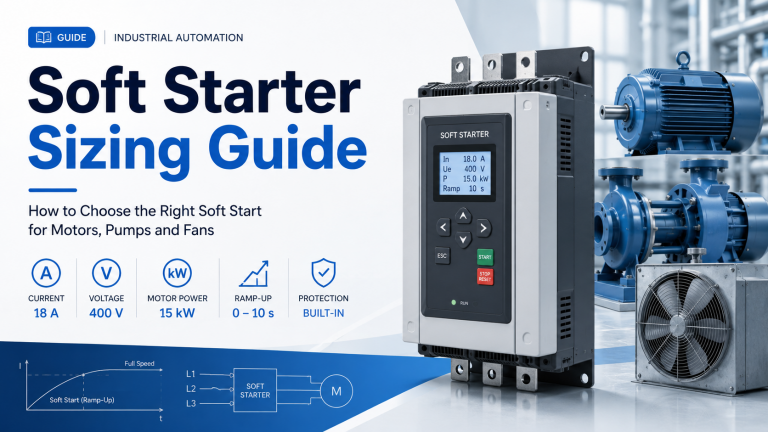
It is important not to confuse VFD output filters with soft starters. A soft starter is used to reduce inrush current and provide smoother motor acceleration during startup, but it does not provide variable speed control in the way a VFD does.
Output filters are specifically used with inverter drives to improve the quality of the inverter output waveform and protect the motor and cable system.
So while both products support motor control systems, they solve completely different problems.
How to Choose the Right Output Filter
Choosing between a dV/dt filter and a sine wave filter usually comes down to the level of protection required and the nature of the installation.
A dV/dt filter is often the right option when you want:
- Protection against voltage spikes
- A practical solution for moderately long cable runs
- Lower cost than a sine wave filter
- Improved motor insulation protection without full waveform conversion
A sine wave filter is often the better option when you want:
- Maximum motor protection
- A near-sinusoidal waveform at the motor
- Reduced motor heating and noise
- Better suitability for very long cable runs or older motors
If you are reviewing suitable hardware for a system build, you can browse our range of filters, inverter drives, and soft starts to compare options for your motor control application.
Common Mistakes to Avoid
When selecting output filters, there are several common mistakes that can lead to poor performance or unnecessary cost.
- Assuming every VFD installation needs a sine wave filter
- Ignoring cable length when sizing the drive system
- Overlooking the condition and age of the motor
- Choosing no filter at all on long cable applications
- Confusing output filters with EMC input filters or soft starters
The best choice comes from understanding the cable length, motor type, operating environment, and required level of waveform smoothing.
Final Thoughts
VFD output filters are a valuable part of many inverter drive systems, especially where cable runs are long, motors are sensitive, or electrical stress needs to be reduced. While both dV/dt filters and sine wave filters improve motor protection, they do not do exactly the same job.
A dV/dt filter is usually the practical choice for reducing voltage rise and limiting reflected wave stress in standard industrial applications. A sine wave filter is the better choice where you need a much smoother motor supply, lower motor noise, reduced heating, and maximum protection.
If you are selecting components for a new or upgraded drive system, browse our full ranges of filters, inverter drives, and soft starts to find the right solution for your application.