PLC vs VFD Motion Control – When Should Each Be Used?
PLC and VFD technologies are both essential in modern industrial automation, but they do very different jobs. A PLC controls logic, sequencing, inputs, outputs, and machine decisions, while a VFD controls motor speed, torque, and acceleration. In many systems, the best results come from using both together, but understanding when each should take the lead is critical for performance, reliability, and cost-effectiveness.
If you are designing a new machine, upgrading an older control panel, or comparing automation options, it is important to understand the difference between PLC-based control and VFD-based motor control. This guide explains what each device does, when each should be used, and how they often work together in real industrial applications.
If you are selecting components for a project, you can browse our full range of PLCs and CPU units, I/O and control modules, graphic terminals and HMIs, and inverter drives.
What Does a PLC Do?
A PLC, or programmable logic controller, is the main control device used to manage machine logic and automation sequences. It reads inputs from sensors, switches, push buttons, encoders, and other field devices, processes logic based on the programmed instructions, and then sends outputs to motors, valves, relays, contactors, and drives.
In simple terms, the PLC acts as the decision-making brain of the machine.
A PLC is typically responsible for:
- Start and stop sequences
- Interlocks and safety logic
- Timers and counters
- Position or process logic
- Communication with HMIs and other devices
- Coordinating multiple motors or machine sections
For machine builders and panel designers, PLC hardware usually starts with the main CPU unit, then expands with I/O modules and often connects to graphic terminals for operator control.
What Does a VFD Do?
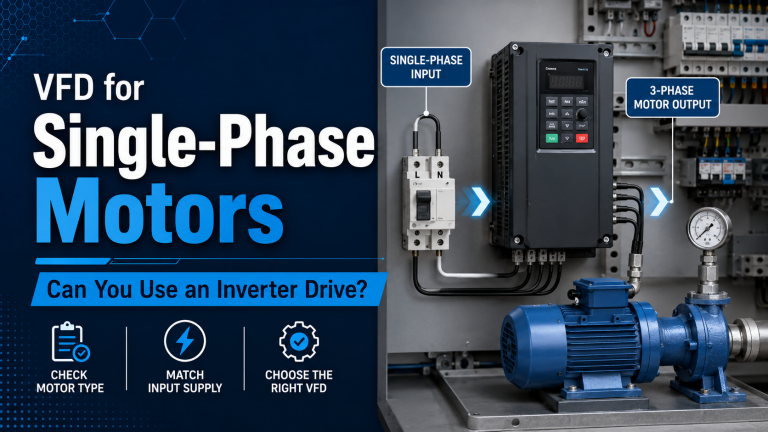
A VFD, or variable frequency drive, is designed specifically to control the speed and torque of an AC motor by varying the output frequency and voltage supplied to the motor. Unlike a PLC, a VFD is not primarily a logic controller. Its main role is motor control.
A VFD is typically used to:
- Start motors smoothly
- Control speed accurately
- Adjust acceleration and deceleration
- Reduce inrush current
- Improve energy efficiency
- Provide motor protection features
This makes inverter drives ideal for fans, pumps, conveyors, mixers, and other applications where variable motor speed is needed.
PLC vs VFD: What Is the Real Difference?
The simplest way to understand the difference is this:
- A PLC controls the process or machine logic
- A VFD controls the motor speed and torque
A PLC decides what should happen and when it should happen. A VFD decides how the motor should run.
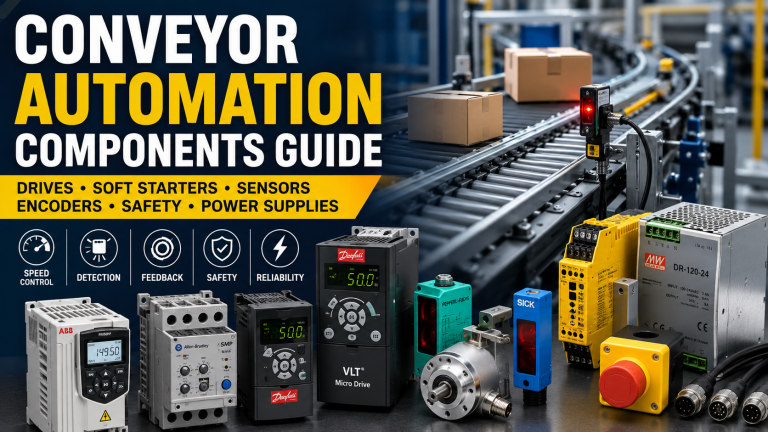
For example, in a conveyor system, the PLC may decide when the conveyor starts, stops, reverses, or changes sequence based on sensors and production conditions. The VFD then controls how fast the conveyor motor runs and how smoothly it accelerates.
When Should a PLC Be Used?
A PLC should be used when the application needs logic-based control, multiple inputs and outputs, sequencing, communication, and machine coordination.
A PLC is the right choice when you need:
- Multiple devices to work together
- Decision-making based on sensors or process conditions
- Timers, counters, and automation sequences
- Integration with HMIs, SCADA, or networks
- Flexible programming for future changes
- Control of several motors or zones at once
Typical applications include packaging lines, batching systems, material handling systems, automated cells, and production machinery where many devices need to be coordinated.
In these systems, the PLC often consists of a central CPU, additional modules, and an operator-facing graphic terminal.
When Should a VFD Be Used?
A VFD should be used when the main requirement is variable motor speed control, smoother starting, energy savings, or adjustable acceleration and deceleration.
A VFD is the right choice when you need:
- Speed control of an AC motor
- Soft starting and stopping
- Reduced mechanical shock
- Improved motor efficiency
- Torque control for certain applications
- Simple standalone motor control
Typical applications include pumps, fans, blowers, conveyors, mixers, and machine drives where changing the motor speed improves process performance.
In these cases, a dedicated inverter drive is usually the correct hardware choice.
When Can a VFD Be Used Without a PLC?
Not every motor application needs a PLC. In simpler systems, a VFD can often run the motor on its own using onboard parameters, digital inputs, analogue speed references, and keypad control.
A standalone VFD may be enough when:
- Only one motor needs to be controlled
- The logic is simple
- Speed is set from a potentiometer or simple signal
- There are no complex sequences or multiple machine zones
- The application only needs local run/stop and speed adjustment
This is common in basic fan and pump systems, smaller conveyors, and retrofit installations where full PLC control would be unnecessary.
When Can a PLC Be Used Without a VFD?
A PLC can also be used without a VFD in applications where the motor only needs simple on/off control at fixed speed. In this case, the PLC controls contactors, relays, or starters rather than variable speed drives.
This approach is suitable when:
- The motor only runs at full speed
- Variable speed is not needed
- The machine logic is complex but motor control is simple
- Cost reduction is more important than speed flexibility
This is often seen in machines with fixed-speed motors, pneumatic sequences, valve control, and general automation panels where the PLC handles the logic but variable motor speed is not part of the design.
When Should PLC and VFD Be Used Together?
In many industrial applications, PLCs and VFDs work best together rather than as alternatives. This is because the PLC handles machine logic while the VFD handles motor performance.
This combined approach is ideal when you need:
- Coordinated machine logic with variable speed motors
- Multiple drives controlled from one central system
- Recipe or process-based speed changes
- Automatic speed adjustment based on sensors
- Operator control through an HMI
- Networked automation systems
For example, in a packaging line, the PLC may monitor sensors, trigger sequences, and control machine states. It then sends commands to one or more VFDs to adjust motor speed depending on product flow, timing, or load conditions.
This is one of the most common and effective automation architectures in industry.
PLC Motion Control vs VFD Motor Control
The phrase “motion control” can sometimes cause confusion because it can refer to very different levels of control.
A VFD provides motor speed control, and in some higher-end applications it can also support torque control and encoder feedback. However, this is not the same as full multi-axis motion control.
A PLC with dedicated motion capability can handle more advanced functions such as:
- Electronic gearing
- Registration and synchronisation
- Cam profiles
- Precise positioning
- Coordinated multi-axis movement
So if the application involves simple speed control, a VFD may be enough. If it involves advanced positioning, synchronisation, or coordinated axes, then PLC-based motion control or a dedicated motion controller becomes much more important.
Examples of When Each Should Be Used
Use a VFD Only
A single extraction fan needs adjustable speed based on airflow demand. No complex machine logic is required. In this case, a VFD alone is often enough.
Use a PLC Only
A machine has several sensors, cylinders, alarms, and timed sequences, but the motor only runs at full speed through a starter. In this case, a PLC handles the logic and no VFD is necessary.
Use PLC and VFD Together
A conveyor system has multiple zones, variable product spacing, sensor-based logic, and speed changes depending on line conditions. In this case, the PLC and VFD should work together.
How HMIs Fit Into the System
In many PLC and VFD systems, an HMI is added so operators can monitor the machine, change settings, view alarms, and adjust speed setpoints.
A graphic terminal or HMI often acts as the user interface between the operator and the control system. It may communicate with the PLC, which then communicates with the VFD, or in simpler cases directly with the drive.
This allows easier setup, better diagnostics, and more flexible operation in industrial environments.
Key Questions to Ask Before Choosing
When deciding whether to use a PLC, a VFD, or both, it helps to ask a few practical questions:
- Does the motor need variable speed control?
- Does the machine require logic, sequencing, or interlocks?
- Are multiple devices or motors being coordinated?
- Does the application need operator screens or network communication?
- Is simple standalone control enough, or is full automation required?
The more logic, sequencing, and communication you need, the more important the PLC becomes. The more speed control and motor performance you need, the more important the VFD becomes.
Final Thoughts
PLC and VFD technologies are not direct competitors. They solve different problems and are often strongest when used together.
A PLC should be used when the application needs automation logic, sequencing, interlocks, communication, and machine coordination. A VFD should be used when the application needs variable motor speed, smooth acceleration, reduced mechanical stress, and better energy efficiency.
In many real-world systems, the best answer is not PLC or VFD, but PLC and VFD working together as part of a complete automation solution.
If you are building or upgrading a control system, explore our ranges of CPU units, control modules, graphic terminals, and inverter drives to find the right combination for your application.