PID Control in VFDs Explained – How It Works and When to Use It
Modern Variable Frequency Drives (VFDs) do far more than simply vary motor speed. Most industrial drives include built-in PID control, allowing them to automatically maintain pressure, flow, temperature, or level without the need for an external PLC.
PID control transforms a standard inverter drive into a smart, closed-loop controller — ideal for pumps, fans, compressors, and process systems.
In this guide, we explain what PID control is, how it works inside a VFD, and when to use it with your electric motors, geared motors, and industrial machinery.
What Is PID Control?
PID stands for:
- P – Proportional
- I – Integral
- D – Derivative
It is a control method that continuously adjusts motor speed based on feedback from a sensor to maintain a target setpoint.
Instead of running at fixed speed, the drive automatically increases or decreases speed to keep the process stable.
Simple Example of PID in Action
Imagine a water booster pump that must maintain 4 bar pressure.
- Pressure drops → drive speeds up motor
- Pressure rises → drive slows motor
- Pressure stabilises → speed holds steady
The system automatically adjusts without operator input.
How PID Works Inside a VFD
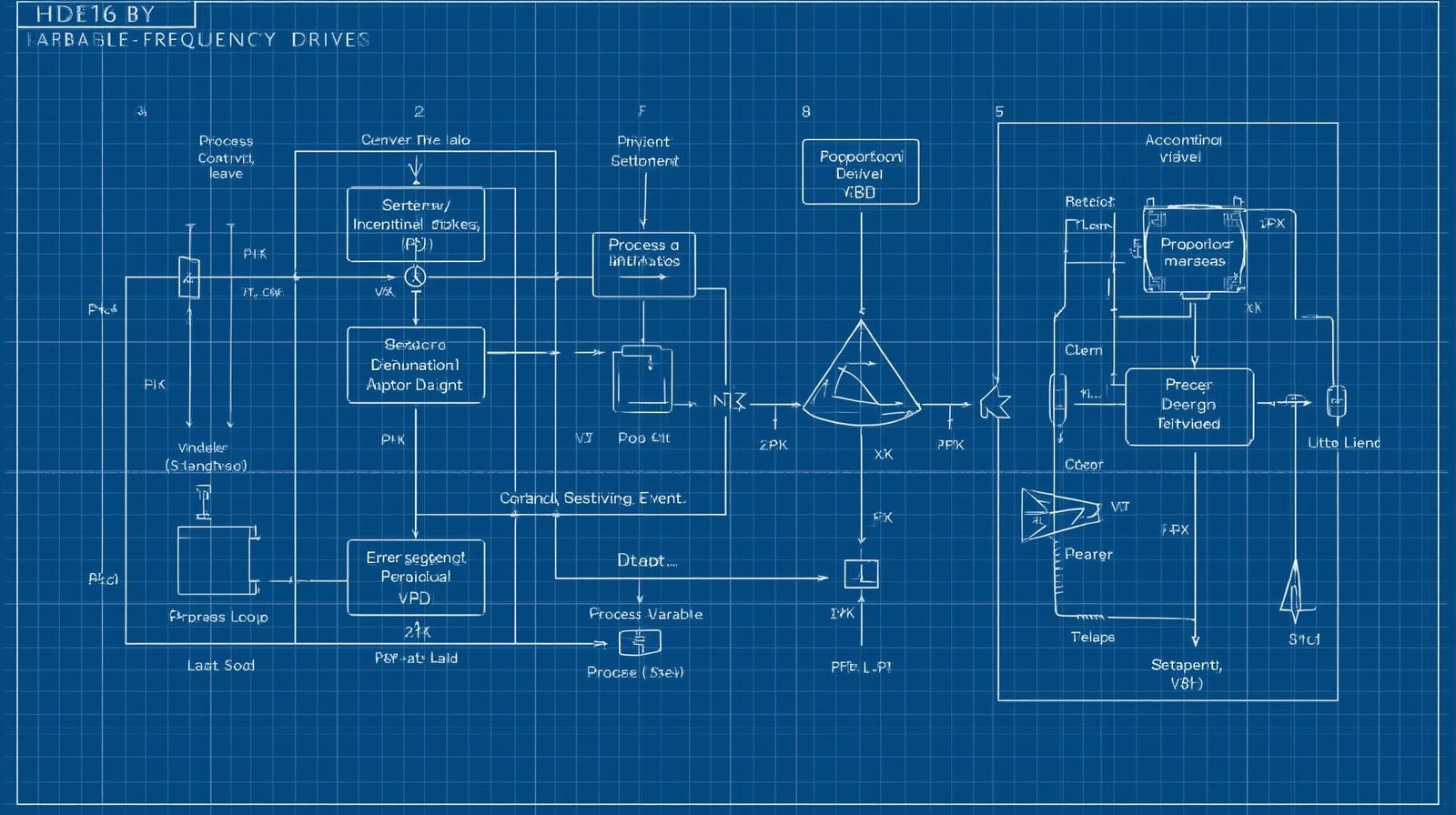
Most modern VFDs include an internal PID loop that works like this:
- Sensor measures process value (pressure, flow, temperature, etc.)
- Signal sent to VFD analogue input (0–10V or 4–20mA)
- Drive compares actual value to target setpoint
- Motor speed automatically adjusted
This is known as closed-loop control.
What Do P, I and D Actually Do?
Proportional (P)
Responds immediately to the size of the error. Bigger error = bigger speed correction.
Integral (I)
Removes steady-state error over time and fine-tunes accuracy.
Derivative (D)
Predicts changes and reduces overshoot or oscillation.
In many pump and fan systems, only P and I are required.
When Should You Use PID Control in a VFD?
PID is ideal when you need to maintain a constant process variable rather than constant speed.
Typical Applications
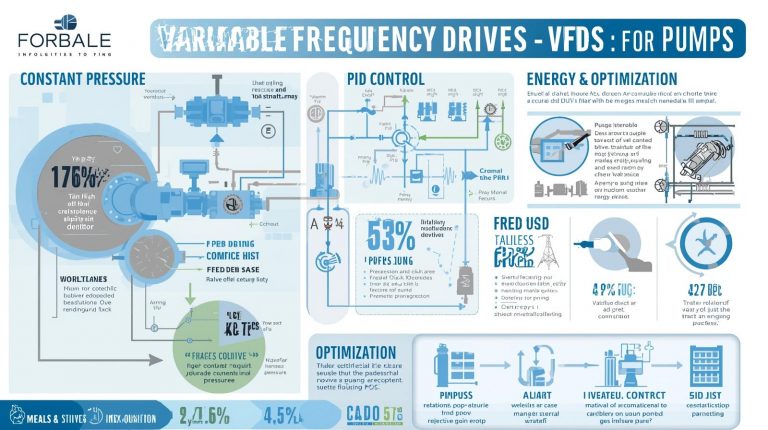
- Constant pressure pumps
- Booster pump systems
- HVAC fans and air handling
- Temperature control loops
- Tank level control
- Flow regulation
In these cases, a simple fixed-speed motor wastes energy and causes poor control.
Benefits of Using PID Inside the VFD
- No external PLC required
- Simpler wiring
- Lower system cost
- Improved stability
- Energy savings
- Automatic adjustment to demand
For many installations, built-in PID is the most cost-effective control method available.
Energy Savings with PID Control
PID reduces speed whenever full output is not required.
For pumps and fans, power consumption follows the cube law:
- 80% speed ≈ 50% power
- 70% speed ≈ 35% power
This means automatic speed reduction can dramatically cut energy bills.
Typical PID Setup Example (Pump System)
Equipment:
- Pressure sensor (4–20mA)
- VFD with PID
- AC motor
Configuration:
- Sensor wired to analogue input
- Set pressure setpoint (e.g. 4 bar)
- Tune P and I gains
- Drive automatically regulates speed
Result: Stable pressure and lower energy usage.
Do All Applications Need PID?
No.
PID is unnecessary when:
- Constant speed is acceptable
- On/off control is sufficient
- No feedback sensor exists
For example, simple conveyors typically use open-loop speed control instead.
Common PID Tuning Mistakes
- P too high → oscillation or hunting
- I too high → slow instability
- No filtering on sensor signal
- Incorrect scaling of analogue input
- Expecting instant response without ramp times
Start with conservative settings and adjust gradually.
Combining PID with Mechanical Design
Correct mechanical sizing improves control quality.
- Properly sized motors avoid overheating
- geared motors provide stable torque at low speed
- gearboxes reduce stress and improve efficiency
Electrical control works best when mechanical sizing is correct.
Frequently Asked Questions
Do all VFDs include PID control?
Most modern industrial drives include built-in PID functions.
Do I need a PLC for PID?
No. The VFD can usually handle it internally.
What sensor types work with PID?
Typically 0–10V or 4–20mA sensors.
Is PID only for pumps?
No. It works for fans, temperature, level, and flow control too.
Does PID save energy?
Yes. By reducing speed automatically, energy use drops significantly.
Need Help Choosing a Drive with PID Control?
At Drive Outlet Megastore, we supply reliable inverter drives, electric motors, geared motors, and complete motion control solutions for pump, fan, and process applications.
If you’re unsure which drive or setup you need, contact our team and we’ll help you select the right solution first time.