Profinet vs EtherNet/IP vs Modbus TCP – Which Industrial Network Should You Use (And Why It Matters for VFDs + PLCs)
If you’re selecting a network for VFDs, PLCs, remote I/O, and HMIs, the choice isn’t just “what cable fits.” Your industrial Ethernet protocol impacts cycle time, determinism, diagnostics, commissioning speed, and ultimately how stable and controllable your drive system feels in the real world.
In this guide we’ll compare Profinet, EtherNet/IP, and Modbus TCP in plain English—then map each one to the practical realities of drive control (start/stop, speed reference, torque, PID loops, alarms, safety, and troubleshooting).
Why the Network Choice Matters for VFDs + PLCs
A VFD can run perfectly well from hardwired I/O (digital start/stop and an analogue 0–10V or 4–20mA reference). But as soon as you scale up—multiple drives, recipe changes, energy reporting, predictive maintenance, faster changeovers—networking becomes the difference between a clean system and a constant headache.
- Control performance: stable speed/torque control depends on predictable update timing.
- Diagnostics: rich alarms, fault history, and parameter access reduce downtime.
- Scalability: adding drives, panels, and I/O should be quick—not a rewiring job.
- Integration: HMIs and SCADA work better when the protocol supports structured tags and device profiles.
If you’re specifying new plant hardware, it helps to choose networking with your whole architecture in mind: Inverter Drives, soft starts, and graphic terminals (HMIs) all benefit from consistent comms and diagnostics.
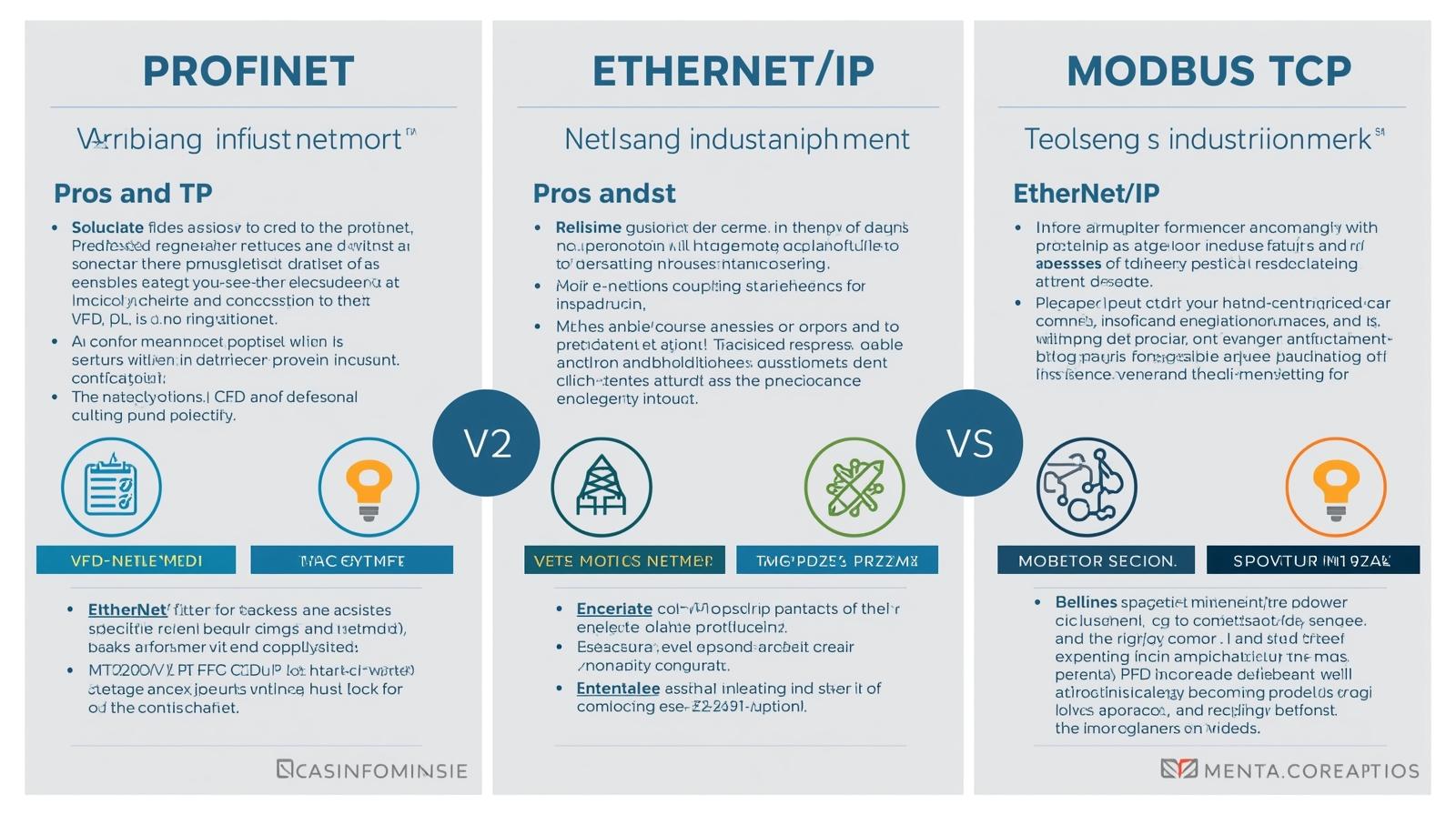
Quick Summary: Profinet vs EtherNet/IP vs Modbus TCP
Profinet (Common in Siemens ecosystems)
- Best for: fast cyclic control + strong diagnostics, especially with Siemens PLCs and drives
- Strengths: device profiles, good diagnostics, flexible topology, deterministic options
- Watch-outs: best experience typically inside a Profinet-focused toolchain
EtherNet/IP (Common in Allen Bradley / Rockwell ecosystems)
- Best for: tag-based control, scalable I/O + drive integration, Rockwell-centric systems
- Strengths: integration with Logix tags, profiles, structured commissioning
- Watch-outs: performance depends on correct RPI, network design, and device support
Modbus TCP (Universal, simple, widely supported)
- Best for: mixed-brand integration, simple read/write control, quick retrofits
- Strengths: easy to implement, inexpensive, broad compatibility
- Watch-outs: fewer standardised diagnostics, mapping is manual, determinism depends on design
What These Protocols Actually Do in a Drive System
For a VFD, industrial Ethernet usually carries two kinds of data:
- Cyclic control data: command word, speed/torque reference, enable bits, and status word back.
- Acyclic/explicit data: parameters, fault logs, diagnostics, energy counters, configuration.
The “feel” of a networked drive system often comes down to how reliably and quickly the PLC can update that cyclic data—especially on multi-drive lines where coordination matters (conveyors, winders, pump skids, packaging machines).
Determinism and Cycle Time: The Big Technical Difference
In industrial control, determinism means you can predict when data updates occur. For VFD control, predictable updates reduce “jitter” that can show up as oscillation, rough speed transitions, and inconsistent response—particularly in tightly tuned loops.
Profinet
Profinet is designed for industrial cyclic communication with strong diagnostic structures. In many real-world systems, Profinet delivers very consistent update timing when engineered correctly (switching, topology, device classes, load).
EtherNet/IP
EtherNet/IP uses CIP with cyclic “implicit messaging” for I/O-style traffic. Performance is often excellent, but it depends heavily on correct configuration (RPI values, managed switches, segmentation, and device capability).
Modbus TCP
Modbus TCP is typically a straightforward client/server polling model. It can be fast enough for many applications, but predictable timing is more dependent on how you engineer polling rates, register grouping, and network load.
Diagnostics: How Fast You Find the Fault
Downtime is where protocol choice pays for itself. When a drive trips at 2am, you want: exact fault codes, time stamps, last states, and clear device identity—without guessing.
Profinet diagnostics
- Strong device identification and diagnostic alarms (when supported by the device)
- Good fit for structured commissioning and maintenance screens
- Often excellent fault visibility inside Siemens environments
EtherNet/IP diagnostics
- Commonly strong tag-level integration and device profiles (especially in Rockwell ecosystems)
- Clear mapping into PLC tags for status, fault, and warnings
- Good for large systems with lots of I/O and drives
Modbus TCP diagnostics
- Diagnostics exist, but you typically build them yourself (register maps, alarm decoding, HMI screens)
- Great for basic control and monitoring, less “plug and play” for advanced fault handling
If you’re building operator screens, protocol choice affects how quickly you can create useful fault pages on graphic terminals without spending days manually mapping registers and bitfields.
Commissioning & Setup: How Quickly You Can Get Running
Profinet
Commissioning is typically smooth when devices support Profinet properly and you’re using a Profinet-friendly toolchain. Device naming, topology discovery, and diagnostics are often strong, which speeds up bring-up on new lines.
EtherNet/IP
In Logix-based systems, EtherNet/IP often feels “native.” Many drives and I/O modules provide add-on profiles, making integration quick: drag in the device, set RPI, map tags, test.
Modbus TCP
Modbus TCP is usually the fastest to get basic comms going, but it can be the slowest to make “polished” at scale because you manually map registers, scaling, and alarms. It’s brilliant for retrofits and mixed-brand sites—just plan your mapping carefully.
Real-World Recommendations (By Scenario)
Scenario A: Siemens PLC + Drives, fast commissioning, strong diagnostics
Choose Profinet if your ecosystem is Siemens-heavy and you want consistent cyclic performance, strong device identity, and easier commissioning within that environment.
Scenario B: Allen Bradley / Rockwell PLCs, tag-based architecture, scalable I/O
Choose EtherNet/IP if your plant standard is Rockwell and you want seamless tag integration for drives, remote I/O, and networked devices.
Scenario C: Mixed-brand retrofit, simple control + monitoring, budget-sensitive
Choose Modbus TCP if you need broad compatibility and you’re happy building your own mapping/diagnostics. It’s a common “universal translator” for sites that have multiple vendors.
Scenario D: Starting/Stopping motors only (no precision control needed)
If you only need basic motor starts with limited speed control, don’t overcomplicate it—many applications are better served with soft starts and simple I/O. Save the network complexity for where it adds value.
Scenario E: Multi-drive conveyor lines, coordinated speed, frequent changeovers
Use a protocol that supports stable cyclic updates and solid diagnostics—often Profinet or EtherNet/IP depending on your PLC platform. This is also where selecting the right inverter drives (with proper comms options) pays dividends.
Common Mistakes That Cause “Bad Networked Drive Control”
- Unmanaged switches: can cause unpredictable traffic behaviour and painful troubleshooting.
- Overloaded networks: too many devices on one segment without planning bandwidth and update rates.
- RPI / update rates set wrong: too fast wastes bandwidth; too slow makes control sluggish.
- Poor register mapping: (Modbus TCP) lots of small reads instead of grouped blocks increases jitter.
- No fault strategy: not mapping trip codes and warnings into the HMI leads to long downtime.
- Ignoring EMC / installation: industrial Ethernet still needs correct cable routing, shielding, and grounding.
FAQ: Choosing an Industrial Ethernet Protocol
Which is “best” overall?
There isn’t one universal winner. The “best” protocol is the one that matches your PLC ecosystem, device support, and maintenance capability. Profinet often shines in Siemens environments, EtherNet/IP in Rockwell environments, and Modbus TCP in mixed-brand or retrofit systems.
Is Modbus TCP too basic for VFD control?
Not necessarily. Many VFD applications run perfectly on Modbus TCP, especially when you group reads/writes properly and design your polling strategy. It’s just less standardised for diagnostics and profiles compared to the other two.
Do I need a network at all?
If your process is simple, hardwired I/O and analogue control may be sufficient. But for multi-drive systems, fast fault finding, energy reporting, and scalable automation, networking is usually worth it.