Single-Phase to Three-Phase Conversion Using VFDs: Complete Setup Guide
Running a three-phase motor on a single-phase supply is one of the most common challenges faced by small workshops, farms, and home-based engineers. Fortunately, the right Variable Frequency Drive (VFD) can convert single-phase input power into a balanced three-phase output — allowing you to run standard industrial motors from domestic or rural supplies. In this guide we’ll cover how single-phase to three-phase conversion works using a VFD, how to size, wire, and commission it correctly, and which models are best suited for the job.
Use our free engineering tools for quick checks and sizing before you buy: VFD Sizing Calculator, VFD Cable Sizing Calculator, Braking Resistor Calculator, and Motor Starter Selection Calculator.
Why Use a VFD for Single-Phase to Three-Phase Conversion?
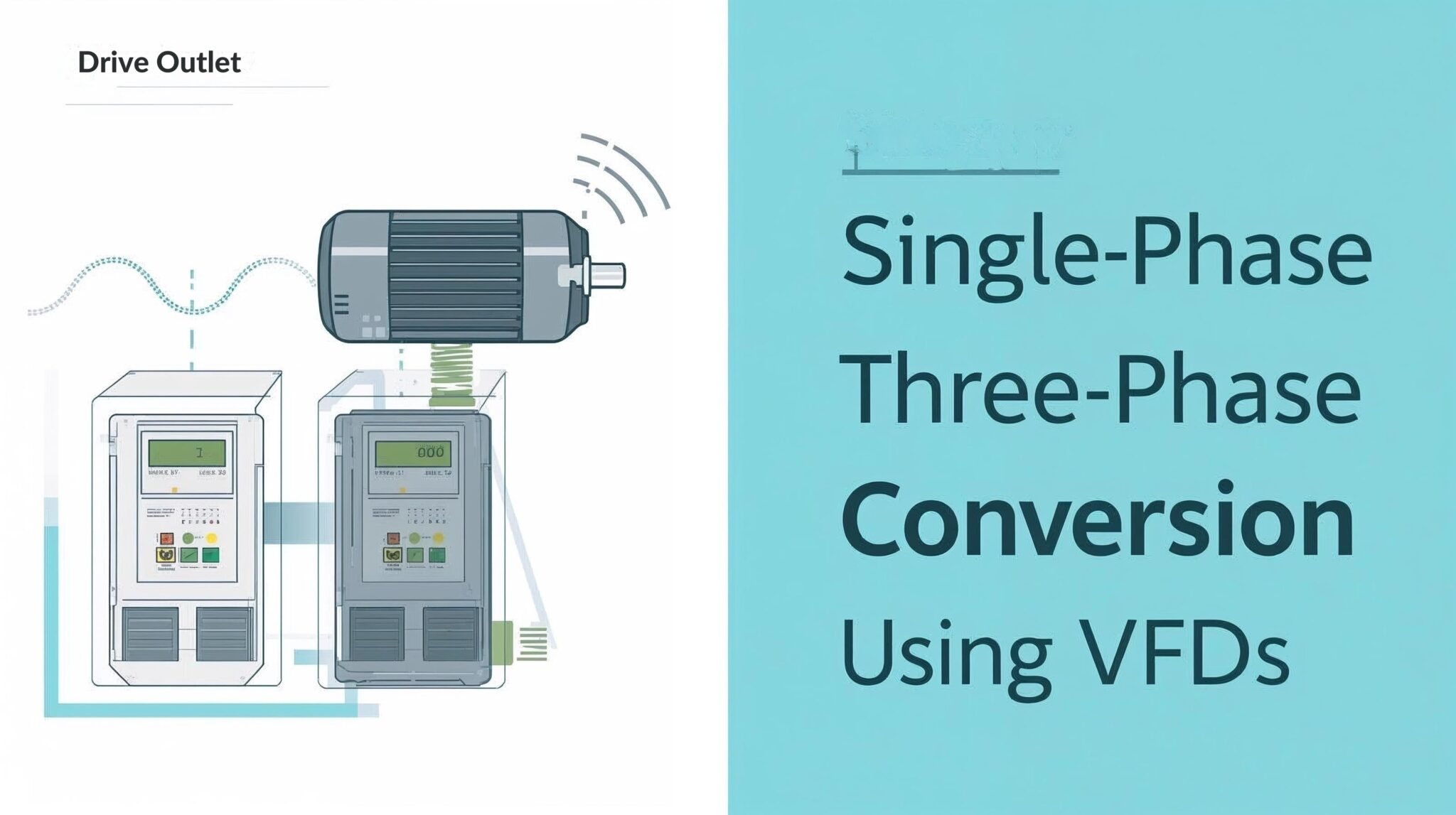
A VFD is more than just a phase converter — it’s an intelligent controller. Instead of simply generating a synthetic third phase, it rectifies single-phase AC to DC, then reconstructs a true three-phase PWM output at adjustable voltage and frequency. This approach offers smooth torque, variable speed, soft starting, and overload protection all in one device.
Compared to static or rotary phase converters, VFDs are:
- ⚙️ More compact and efficient (95–98 %)
- ⚙️ Provide full speed and torque control
- ⚙️ Offer programmable acceleration/deceleration
- ⚙️ Include built-in protection for motor and supply
- ⚙️ Cost less to run and maintain
How It Works: Inside the Conversion Process
1. Rectification
The VFD’s input stage uses a diode bridge to convert single-phase AC (typically 230 V) to DC. The internal DC bus capacitors store energy and smooth the waveform.
2. Inversion
The inverter section uses high-speed IGBTs (insulated gate bipolar transistors) to reconstruct a three-phase AC output. Each phase is pulse-width modulated, producing balanced 120° phase separation suitable for standard motors.
3. Control
By adjusting switching frequency, the VFD precisely controls output frequency (Hz) and voltage (V), enabling full speed control and torque delivery just like a standard three-phase supply.
Applications of Single- to Three-Phase Conversion
This setup is ideal for:
- 🏭 Workshops without three-phase supply running lathes, mills, or compressors
- 🚜 Farms operating augers, pumps, and conveyors
- 🪵 Woodworking shops powering saws and sanders
- 🏠 Domestic or mobile setups needing 3-phase motors on 230 V mains
VFD Sizing for Single-Phase Input
When using a VFD as a phase converter, the input current increases significantly because the same power must pass through only two incoming lines instead of three. For this reason, you must oversize the drive relative to the motor’s rated current.
General rule of thumb:
- ➡️ For light/medium duty: select a VFD rated 1.5–2 × the motor’s FLA
- ➡️ For heavy torque loads: choose 2–2.5 × rated current
Use the VFD Sizing Calculator to enter motor power, input voltage, and load type to find the correct drive rating with sufficient headroom for single-phase input.
Wiring Overview
Input Side (Single-Phase Supply)
- Connect L1 and L2 (or L and N) to the VFD input terminals — leave L3 empty.
- Connect protective earth (PE) to the ground terminal.
- Use correctly sized shielded cable per the Cable Sizing Calculator.
Output Side (Three-Phase to Motor)
- Connect U, V, W from the VFD to the motor terminals (T1, T2, T3).
- Ensure the motor is connected in delta (Δ) for 230 V operation if using a 400 V 3-phase motor on single-phase input.
- Bond motor frame to earth for EMC compliance.
Startup & Parameter Settings
Once wired, set up the drive parameters before energising:
- ✅ Enter correct motor nameplate data (V, A, Hz, poles)
- ✅ Set acceleration/deceleration ramps (e.g., 5–10 s)
- ✅ Select control mode (V/F or sensorless vector)
- ✅ Define run/stop and speed reference source (keypad, terminal, or potentiometer)
- ✅ Enable motor thermal protection and overload limits
Best VFD Brands for Single-Phase to Three-Phase Conversion
Invertek Optidrive E3 Series
- ✔️ Accepts 230 V single-phase input up to 2.2 kW
- ✔️ Provides true 3-phase 230 V output
- ✔️ Built-in EMC filter and keypad
- ✔️ Compact IP20 or IP66 models ideal for standalone machinery
- 🔗 Popular model: ODE-3-120070-1F1A Optidrive E3 0.75 kW
Delta VFD-EL & MS300 Series
- ✔️ 230 V single-phase in / three-phase out up to 3 kW
- ✔️ Flying-start & DC braking functions
- ✔️ Compact and cost-effective for small machinery
- 🔗 Popular model: VFD022E21A (2.2 kW)
Allen Bradley PowerFlex 523/525
- ✔️ Single-phase 230 V input versions available up to 1.5 kW
- ✔️ Full vector control with parameter wizards
- ✔️ Ethernet/IP & RS-485 comms for automation integration
- 🔗 Example: 25A-D010N114 (1.5 kW)
Siemens SINAMICS V20 Compact Drive
- ✔️ Accepts 1-phase 230 V input / 3-phase 230 V output up to 1.5 kW
- ✔️ Simple dial/keypad interface
- ✔️ Reliable choice for fans, pumps, and workshops
Yaskawa V1000 and GA500 Drives
- ✔️ Accepts 1-phase supply up to 3 kW
- ✔️ Industry-leading reliability and overload capacity
- ✔️ Compatible with induction & permanent-magnet motors
Braking, Filtering, and EMC Tips
- 🏁 Add a braking resistor when frequent deceleration is needed — size it using the Braking Resistor Calculator.
- 🧲 Use short, shielded motor cables and 360° grounding for EMC compliance — calculate wire gauge with the Cable Sizing Calculator.
- ⚡ Fit an input line reactor if your supply is prone to surges or harmonic distortion.
Common Mistakes to Avoid
- ❌ Undersized drive — always oversize for single-phase input.
- ❌ Incorrect motor connection (must be Δ for 230 V systems).
- ❌ Running multiple motors from one drive (only one motor per VFD unless specially designed).
- ❌ Skipping proper earthing or shield termination.
- ❌ Ignoring ventilation — VFDs dissipate heat; mount with adequate clearance.
Example Setup: 2.2 kW Workshop Lathe
Input: 230 V AC (single-phase). Output: 3-phase 230 V to motor. Drive: Invertek Optidrive E3 2.2 kW. Result: full torque across speed range, smooth start/stop, and reduced power bills compared to static phase converters.
Troubleshooting & FAQs
Can I power multiple machines from one VFD?
No — each VFD should power one motor. Switching motors on a single VFD output risks damaging the inverter.
Will a 230 V single-phase VFD run a 400 V three-phase motor?
Only if the motor can be wired in delta for 230 V operation. Otherwise, use a transformer or 400 V VFD on a 230→400 V converter.
Do I need a neutral connection?
No — single-phase VFDs use L1–L2 (or L–N) for input; neutral is not used on the output side.
Conclusion: Simple, Reliable Phase Conversion with VFDs
Using a VFD for single- to three-phase conversion provides the best of both worlds: genuine three-phase performance and fine speed control — all from a standard domestic supply. The setup is straightforward, cost-effective, and far more flexible than traditional converters.
Before ordering, use our: VFD Sizing Calculator, Cable Sizing Calculator, and Braking Resistor Calculator to confirm the ideal configuration.
Then explore our best-selling single-phase compatible drives from Invertek, Delta, Allen Bradley, Siemens, and Yaskawa — all in stock and ready for next-day UK delivery.
At Drive Outlet Megastore, we supply genuine OEM drives at unbeatable prices. Contact our expert team for help choosing your perfect single-phase to three-phase solution today.