How to Size a VFD Correctly for Motor Power and Load Type
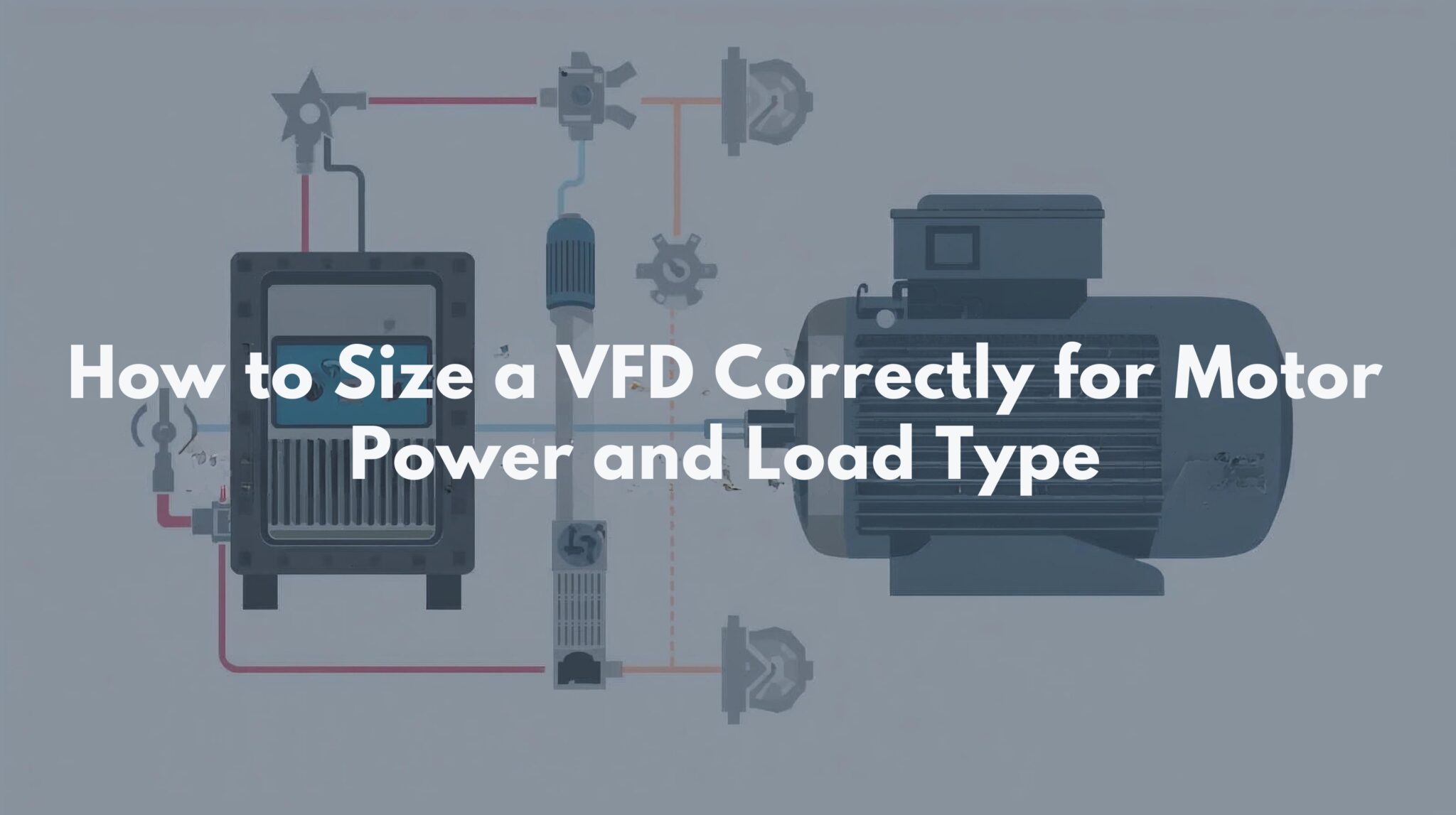
Choosing the correct Variable Frequency Drive (VFD) for your motor is one of the most important steps in ensuring long-term reliability, energy efficiency, and protection of your industrial system. Whether you’re running pumps, fans, conveyors, or compressors, correct VFD sizing prevents overloads, nuisance trips, and premature motor failures — while maximising performance and energy savings.
In this comprehensive guide, we’ll cover exactly how to size a VFD for motor power and load type, including step-by-step calculations, safety margins, and how to use our VFD Sizing Calculator to simplify the process.
Understanding What a VFD Does
A Variable Frequency Drive (VFD) — also known as an inverter drive — controls the speed and torque of an AC motor by adjusting the frequency and voltage supplied to it. This allows precise speed control, soft starting, and reduced energy consumption. Common applications include fans, pumps, conveyors, mixers, and HVAC systems.
By varying motor speed, a VFD not only improves process control but also extends mechanical component life and significantly reduces electrical energy costs. However, to achieve these benefits, the drive must be sized correctly to match the motor power (kW/HP) and load type.
Step 1: Identify Motor Power and Voltage
The first step in VFD sizing is identifying your motor’s nameplate data. Every motor should specify:
- Rated Power: e.g. 2.2 kW or 3 HP
- Voltage: 230V single-phase, or 400V three-phase
- Current (Full Load Amps): Motor FLA rating
- Speed (RPM): Typically 1,500 or 3,000 RPM for 4-pole or 2-pole motors
- Frequency: 50 Hz (Europe) or 60 Hz (US)
Once you have these parameters, the easiest way to size your inverter is by using our free online VFD Sizing Calculator. Simply enter your motor’s kW, voltage, and load type to get the recommended inverter drive rating instantly.
Step 2: Determine Load Type (Constant Torque vs Variable Torque)
Different applications place different demands on a drive. Choosing the correct VFD rating depends heavily on whether the motor drives a constant torque or variable torque load.
Constant Torque Loads
Examples: conveyors, positive displacement pumps, hoists, mixers, and crushers.
These applications demand the same torque across the speed range. VFDs for constant torque loads must be rated for higher current because they experience heavier loads at lower speeds.
Variable Torque Loads
Examples: centrifugal pumps and fans.
These loads require torque proportional to the square of the speed, meaning they draw less current at lower speeds. As a result, a smaller drive can often be used compared to a constant torque application with the same motor.
When in doubt, size for constant torque — it provides additional safety margin.
Step 3: Check Motor Full Load Current (FLA)
Always verify that the selected VFD can handle your motor’s full load current. Even if the kW matches, the drive must have sufficient current capacity to handle starting, acceleration, and overload conditions.
Compare your motor’s FLA with the VFD’s rated output current in the manufacturer’s datasheet. For example, a 4 kW 400V three-phase motor may have an FLA of around 8.2A, so the inverter’s continuous output current should be at least equal or greater — ideally with a 10–15% margin.
Step 4: Apply a Safety Margin
It’s always wise to select a VFD slightly larger than the motor rating to ensure reliability and future-proofing. Standard practice is to add a:
- ✅ 10–15% margin for variable torque loads
- ✅ 20–25% margin for constant torque loads
- ✅ Up to 50% margin for high-inertia or cyclic loads (e.g. crushers, centrifuges)
This ensures the inverter doesn’t run at full load continuously, preventing overheating and extending lifespan.
Step 5: Consider Starting Torque and Overload Capacity
Some loads demand a high starting torque — for instance, heavy conveyors or mixers that start under load. In these cases, the drive must handle a short-term overload current of 150–200% of rated value. Check the inverter’s overload specification, typically:
- 150% for 60 seconds (light/normal duty)
- 180–200% for 3 seconds (heavy duty)
For demanding loads, choose the heavy-duty rating or a slightly larger drive model.
Step 6: Check Power Supply Type and Phase
VFDs are available for single-phase input and three-phase input configurations. Selecting the right input type is critical:
- Single-phase input, 230V: Suitable for small motors up to ~3 kW.
- Three-phase input, 400V: Standard for most industrial motors above 0.75 kW.
If you’re unsure which to use, our Motor Starter Selection Calculator can help you identify the ideal starting and control method for your setup.
Step 7: Match Environmental Ratings (IP Rating & Cooling)
The inverter’s environmental protection level should suit the installation area:
- IP20: Clean, dry control panels
- IP55 / IP66: Dusty or wet industrial environments
For outdoor or harsh-duty installations, consider models like the Invertek Optidrive E3 IP66 series — ideal for washdown or field-mounted systems.
Step 8: Evaluate Braking Requirements
In applications with deceleration or regenerative loads (e.g. hoists, lifts, centrifuges), you may need a braking resistor to safely dissipate excess energy. Selecting the right resistor prevents drive overvoltage trips and damage.
Use our Braking Resistor Calculator to determine the optimal resistance and power rating for your system. Many drives, such as ABB ACS355 and Allen Bradley PowerFlex series, include built-in braking transistor terminals for plug-and-play connection.
Step 9: Check Cable Sizing and Installation Distance
Incorrect cable sizing can cause voltage drop, interference, or tripping issues. Cable length also affects the inverter’s output waveform due to reflected waves.
We recommend using our free VFD Cable Sizing Calculator to ensure correct conductor size based on distance, load, and current. For longer cable runs, consider shielded cables or dv/dt filters to protect the motor insulation.
Step 10: Account for Motor Type and Special Features
Modern inverters can control more than just standard induction motors — including permanent magnet (PM), synchronous reluctance (SynRM), and servo motors. Always ensure the selected VFD supports your motor type and feedback method (sensorless or encoder feedback).
Popular compatible drives include:
- ABB ACS880 Industrial VFDs
- Allen Bradley PowerFlex 523 & 525
- Danfoss VLT Micro Drive FC-51
- Invertek Optidrive E3
- Delta MS300 Series
Step 11: Include Built-In Protections and Functions
Beyond simple motor control, the right drive should provide safety and diagnostic features such as:
- ✅ Overcurrent, overvoltage, and under-voltage protection
- ✅ Motor thermal overload protection (I²t)
- ✅ Short-circuit and ground fault protection
- ✅ PID control for pumps and fans
- ✅ Built-in EMC filter for noise suppression
These features improve reliability, simplify panel design, and reduce the need for external components.
Step 12: Perform Final Verification and Test Run
Before powering up, verify the following checklist:
- ✔ Correct wiring and grounding per manufacturer’s guide
- ✔ Motor parameters (FLA, power, voltage) entered correctly
- ✔ Control signals (start/stop, speed reference) tested
- ✔ Braking resistor connected and configured if applicable
- ✔ Drive set to correct acceleration/deceleration times
After setup, perform a test run at low speed to ensure smooth operation and correct rotation direction. Gradually increase load while monitoring current and temperature.
Common Mistakes When Sizing a VFD
- ❌ Selecting a VFD by kW only — always check motor current
- ❌ Ignoring duty cycle or high-inertia loads
- ❌ Forgetting to include a braking resistor for regenerative systems
- ❌ Using undersized cables — causes voltage drop and overheating
- ❌ Not verifying input phase or voltage compatibility
Avoiding these mistakes will drastically improve system longevity and prevent costly downtime.
Conclusion: Simplify Your VFD Sizing with Drive Outlet Megastore
Correctly sizing a VFD is essential for safe, efficient, and long-lasting motor control. By understanding your motor’s power, load type, and environmental conditions — and by applying the right safety margins — you can ensure a trouble-free installation that saves energy and protects your equipment.
To make it easier, use our free tools:
- ⚙️ VFD Sizing Calculator
- ⚙️ VFD Cable Sizing Calculator
- ⚙️ Braking Resistor Calculator
- ⚙️ Motor Starter Selection Calculator
Once you’ve calculated your ideal drive, explore our full range of industry-leading brands below:
- ABB Inverter Drives
- Allen Bradley PowerFlex Drives
- Danfoss VLT Drives
- Invertek Optidrive E3
- Delta MS300 & VFD-EL Series
At Drive Outlet Megastore, we stock thousands of genuine inverter drives at the UK’s lowest prices — all available for fast delivery and backed by a 2-year warranty. Use our calculators, explore our brands, or contact our expert team for professional advice today.