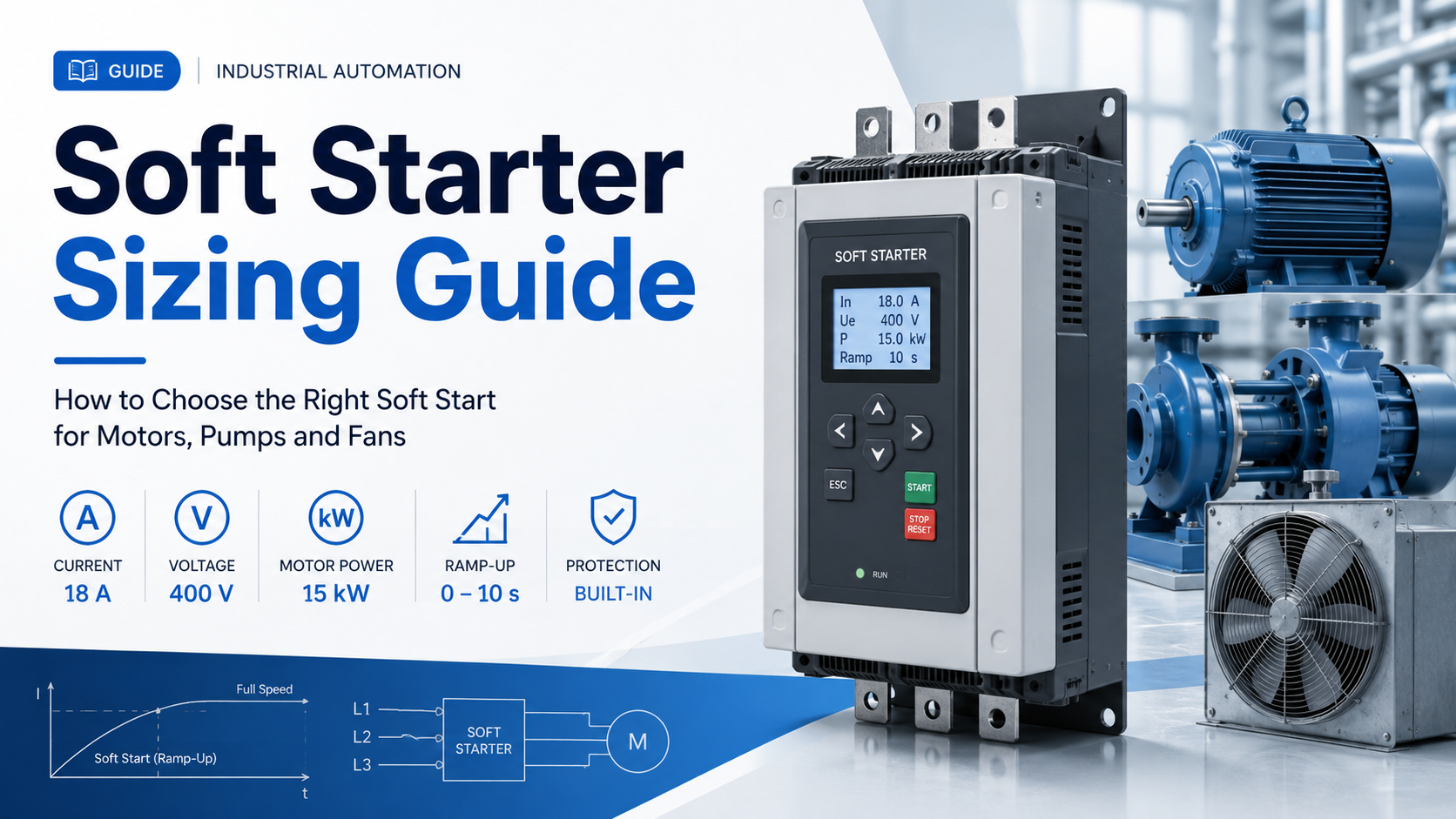
Soft Starter Sizing Guide: How to Choose the Right Soft Start for Motors, Pumps and Fans
Choosing the right soft starter is important if you want smoother motor starting, reduced mechanical stress, lower inrush current and better protection for pumps, fans, conveyors and other industrial machines. A soft starter does not control motor speed in the same way as an inverter drive, but it is often the right choice when the motor only needs controlled starting and stopping rather than full variable speed control.
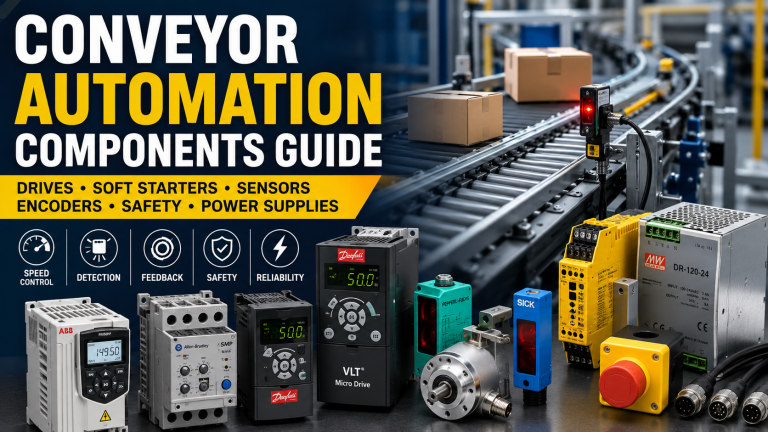
At Drive Outlet Megastore, we supply a wide range of soft starts, including ABB Soft Starts, Allen Bradley Soft Starts and Danfoss Soft Starts for industrial motor control applications.
What Is a Soft Starter?
A soft starter is an electronic motor starting device used to gradually increase the voltage supplied to an electric motor during start-up. Instead of applying full voltage instantly, the soft starter ramps the motor up smoothly. This helps reduce electrical inrush current and limits sudden mechanical shock on couplings, belts, pumps, fans, gearboxes and driven machinery.
Soft starters are commonly used on three-phase motors where full-speed running is required, but harsh direct-on-line starting would place too much stress on the electrical supply or the mechanical system.
Typical soft starter applications include:
- Pumps where smooth starting and stopping helps reduce water hammer
- Fans and blowers where belt slip and mechanical stress need to be reduced
- Conveyors where smoother acceleration protects belts, rollers and gearboxes
- Compressors where controlled starting reduces load shock
- Mixers, agitators and general industrial machinery
Soft Starter vs Direct Online Starting
Direct online starting, often called DOL starting, applies full voltage to the motor immediately. This is simple and cost-effective, but it can create a large inrush current and a sudden torque shock. On smaller motors this may not be an issue, but on larger motors or sensitive machinery it can cause nuisance tripping, voltage dips, belt wear, coupling damage and premature mechanical failure.
A soft starter improves the start by gradually increasing the motor voltage over a set ramp time. This gives a smoother acceleration and reduces the impact on both the power supply and the driven equipment.
For example, a pump started direct online may create a sharp pressure surge in the pipework. A soft starter can ramp the pump up more gently, helping reduce stress on pipework, valves and seals. For fans, a soft starter can reduce belt shock and help prevent sudden load spikes at start-up.
If the application only needs smooth starting and stopping, a soft starter is often a practical choice. If the motor needs adjustable speed during operation, then an inverter drive is usually the better option.
How to Size a Soft Starter Correctly
The correct way to size a soft starter is to start with the motor nameplate and the application. Do not choose only by motor kW. Motor current, supply voltage, starting load, duty cycle and stopping requirements all matter.
1. Check the Motor Power Rating
The motor kW or horsepower rating gives you the first sizing guide. For example, a 7.5kW motor will usually need a soft starter rated for at least that motor size at the correct supply voltage. However, kW alone is not enough because two motors with the same kW rating can have different full load currents depending on design, efficiency and voltage.
2. Match the Soft Starter to the Motor Full Load Current
The motor full load current, usually shown as FLC or FLA on the motor nameplate, is one of the most important values. The selected soft starter should be rated for the motor current under the correct duty conditions.
If the motor nameplate shows a full load current of 32A, the soft starter must be suitable for that current and the type of application. For heavy-duty loads or frequent starts, you may need to choose a larger soft starter than the basic motor kW chart suggests.
3. Confirm the Supply Voltage
Soft starters are designed for specific voltage ranges. Before selecting a unit, confirm whether the motor and supply are 230V, 400V, 415V, 480V or another industrial voltage. Using a soft starter outside its voltage range can cause faults or damage.
This is especially important when sourcing replacement soft starters for existing panels, exported machinery or older installations.
4. Consider the Application Type
The driven load makes a big difference. A lightly loaded fan is easier to start than a heavily loaded conveyor, crusher, mixer or compressor. Pumps and fans are common soft starter applications, but they may need different ramp settings and stopping behaviour.
As a general guide:
- Pumps: Look for smooth start and soft stop control to reduce pressure shock.
- Fans: Check start time, inertia and belt-driven load requirements.
- Conveyors: Consider starting torque, load weight and restart frequency.
- Compressors: Check whether the compressor starts unloaded or under pressure.
- Mixers: Heavy starting loads may require a higher-rated soft starter.
5. Check Duty Cycle and Starts Per Hour
A soft starter used once or twice per hour has a different thermal demand compared with one used repeatedly throughout the day. Frequent starts create more heat inside the soft starter and motor, so duty cycle must be checked carefully.
If the motor starts frequently, runs in a hot control panel, or starts under heavy load, choose the soft starter based on the manufacturer’s duty rating rather than only the motor kW.
6. Decide Whether You Need Built-In Bypass
Many modern soft starters include an internal bypass contactor. Once the motor reaches full speed, the bypass reduces heat and improves running efficiency by taking the power electronics out of the main current path.
Built-in bypass can simplify panel design and reduce heat build-up. For control panels with limited space or higher current motors, this is an important feature to check.
7. Check Motor Protection and Overload Features
Some soft starters include motor protection features such as overload protection, phase loss detection, current limit, underload protection or fault diagnostics. Others may need separate overload relays or external protective devices.
For a complete motor control panel, you may also need suitable circuit breakers, control fuses, contactors, relays and power supplies.
Best Applications for Soft Starts
Soft starters are ideal when the motor needs to run at fixed speed but requires a smoother start or stop. They are often used where the main problem is high inrush current, mechanical shock or pressure surge.
Pumps
Pumps are one of the most common soft starter applications. A correctly selected soft starter can reduce start-up stress and help prevent water hammer during stopping. This is useful in water treatment, process plants, irrigation, HVAC and industrial pumping systems.
Fans and Blowers
Fans and blowers often have high inertia. A soft starter can reduce belt strain, coupling shock and electrical stress during acceleration. For basic fixed-speed air movement, a soft starter can be a good alternative to a VFD.
Conveyors
Conveyors benefit from controlled acceleration because sudden starting can shock belts, rollers, gearboxes and products on the line. For conveyors that only run at one speed, a soft starter can be a simple and cost-effective option.
Compressors
Compressors can require careful selection depending on whether they start loaded or unloaded. Always check the motor current, compressor type and start conditions before choosing the soft starter size.
When to Use a VFD Instead
A soft starter is not a speed controller. Once the motor is running, it normally runs at full supply frequency and full speed. If the application needs speed adjustment, process control, energy savings through speed reduction, torque control or communication with automation systems, an inverter drive is usually the better choice.
For variable speed motor control, Drive Outlet Megastore supplies a wide range of inverter drives including ABB ACS580-01 Inverter Drives, Allen Bradley PowerFlex 525 Inverters, Danfoss VLT AutomationDrives, Schneider ATV320 Inverter Drives and Siemens SINAMICS G120C Inverter Drives.
Use a VFD instead of a soft starter when you need:
- Variable motor speed during normal operation
- Energy saving on pumps and fans by reducing speed
- Precise acceleration and deceleration control
- Closed-loop speed or torque control
- Analogue, digital or fieldbus control from a PLC
- Advanced diagnostics and motor control features
Use a soft starter when you only need smoother starting and stopping at fixed speed.
ABB vs Allen Bradley vs Danfoss Soft Starts
ABB, Allen Bradley and Danfoss are all well-known industrial automation brands, and each range is commonly used in motor control panels, OEM machinery and process applications.
ABB Soft Starts
ABB Soft Starts are commonly used across pumps, fans, compressors, conveyors and general industrial motor starting applications. ABB soft starters are a strong choice for buyers who already use ABB drives, switchgear or automation equipment.
Allen Bradley Soft Starts
Allen Bradley Soft Starts are widely used in industrial plants, control panels and automation systems where Rockwell Automation equipment is already installed. They are a popular option for machine builders and maintenance teams replacing existing Allen Bradley motor control products.
Danfoss Soft Starts
Danfoss Soft Starts are often used in pump, fan, HVAC and process control applications. They are a good fit for sites that already use Danfoss VLT drives or Danfoss motor control equipment.
The best brand usually depends on the existing control panel, site standard, communication requirements, available space, motor size and application duty.
Common Soft Starter Buying Mistakes
Choosing by kW Only
The most common mistake is choosing a soft starter only by motor kW. Always check motor full load current, voltage and duty rating.
Ignoring Heavy-Duty Starting
Some applications need more starting torque or longer ramp times. Heavy conveyors, compressors and mixers may need a larger unit than a standard pump or fan application.
Using a Soft Starter When a VFD Is Needed
If the process needs speed control, a soft starter is not the correct product. Choose an inverter drive instead.
Not Checking Bypass Requirements
For many industrial panels, built-in bypass can reduce heat and simplify installation. If the selected soft starter does not include bypass, you may need an external bypass contactor.
Forgetting Panel Protection
A soft starter is only one part of the motor control system. You may also need suitable Schneider Electric Circuit Breakers, Siemens Circuit Breakers or Allen Bradley Circuit Breakers depending on the panel design and site standard.
Quick Soft Starter Selection Checklist
Before ordering a soft starter, check the following details:
- Motor power: Confirm the motor kW or horsepower rating.
- Motor current: Check the full load current on the motor nameplate.
- Supply voltage: Confirm the input voltage and phase.
- Application: Identify whether the load is a pump, fan, conveyor, compressor or heavy-duty machine.
- Start frequency: Check how many starts per hour are required.
- Ramp time: Decide how quickly the motor needs to accelerate and decelerate.
- Bypass: Check whether internal bypass is required.
- Protection: Confirm overload, phase loss and fault protection requirements.
- Panel space: Check dimensions, ventilation and enclosure temperature.
- Brand preference: Match the existing site standard where possible.
Shop Related Soft Starts, Drives and Motor Control Products
Use the links below to browse relevant motor control categories at Drive Outlet Megastore:
- Soft Starts
- ABB Soft Starts
- Allen Bradley Soft Starts
- Danfoss Soft Starts
- Inverter Drives
- ABB ACS580-01 Inverter Drives
- Allen Bradley PowerFlex 525 Inverters
- Danfoss VLT AutomationDrives
- Schneider ATV320 Inverter Drives
- Siemens SINAMICS G120C Inverter Drives
- Circuit Breakers
- Schneider Electric Circuit Breakers
- Siemens Circuit Breakers
- Allen Bradley Circuit Breakers
- Power Supplies
Soft Starter Sizing FAQs
Do I size a soft starter by kW or amps?
You should use both, but motor full load current is the most important figure. The motor kW gives a quick reference point, but the soft starter must be suitable for the motor current, voltage and application duty.
Can I use a soft starter instead of an inverter drive?
Yes, but only if the motor runs at fixed speed and you only need controlled starting or stopping. If the motor needs variable speed control, choose an inverter drive instead.
Are soft starters suitable for pumps?
Yes. Pumps are one of the most common soft starter applications. A soft starter can help reduce start-up shock and soft stop control can help reduce water hammer in suitable systems.
Are soft starters suitable for fans?
Yes. Soft starters are often used on fans and blowers to reduce belt stress, mechanical shock and electrical inrush during start-up.
Do I need a bypass contactor with a soft starter?
Some soft starters have built-in bypass, while others may require an external bypass contactor. Built-in bypass can reduce heat and simplify panel design, so it is worth checking before ordering.
Can a soft starter reduce energy use?
A soft starter mainly reduces starting stress and inrush current. It does not normally save energy during full-speed running in the same way as a VFD on variable speed pump or fan applications.
Need Help Choosing a Soft Starter?
If you are replacing an existing soft starter or sizing a new one for a motor, pump, fan, conveyor or compressor, Drive Outlet Megastore can help you source the right industrial motor control equipment. Browse our full range of Soft Starts, Inverter Drives, Circuit Breakers and Power Supplies online.
Drive Outlet Megastore supplies industrial automation parts across the UK and worldwide, including ABB, Allen Bradley, Danfoss, Schneider Electric, Siemens and more. Search by part number or contact us for help matching a soft starter to your motor and application.