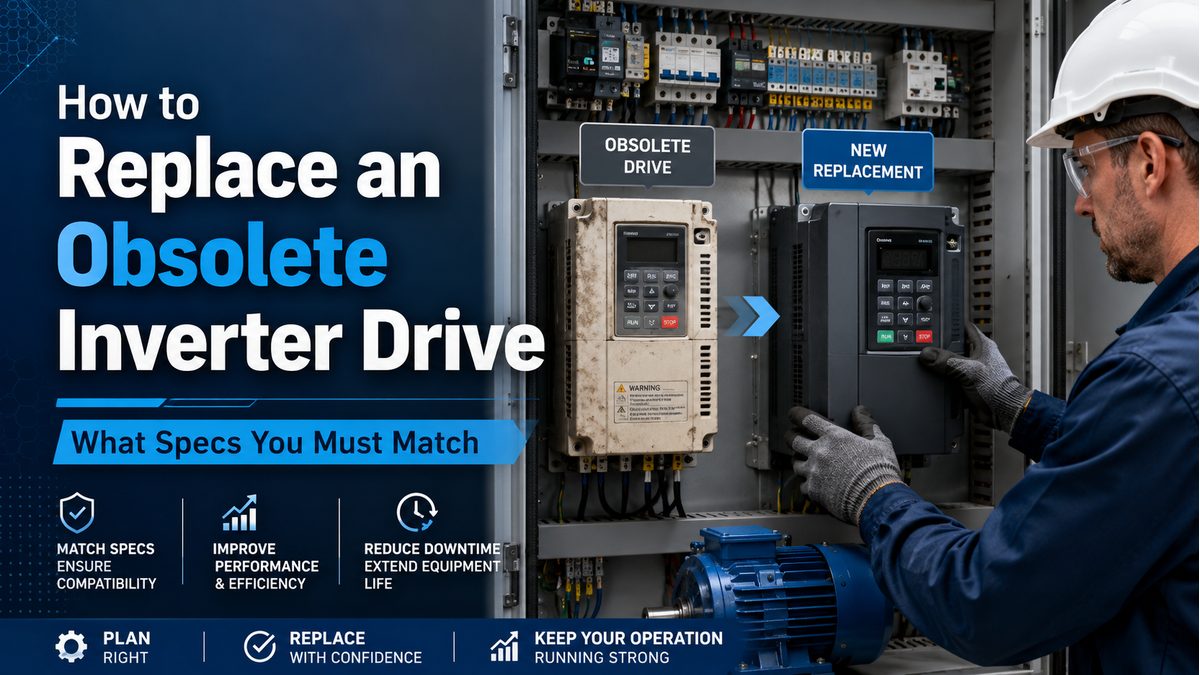
How to Replace an Obsolete Inverter Drive: What Specs You Must Match
Replacing an obsolete inverter drive can feel risky, especially when the original model is discontinued, the part number no longer appears online, or the machine has been running the same drive for years. The good news is that you usually do not need the exact same model to get the machine running again. In most cases, you need a suitable replacement inverter drive that matches the key electrical, mechanical and control requirements of the original unit.
The most important thing is not just matching the kilowatt rating. A correct replacement must also suit the motor voltage, input supply, output current, overload demand, control method, braking setup, enclosure rating, communication requirements and available panel space. This guide explains exactly what to check before replacing an obsolete VFD, AC drive or inverter drive.
1. Match the Input Voltage and Phase Supply
The first specification to check is the incoming supply voltage. This tells you what power the replacement drive must accept from the mains or control panel. Common supply types include 1-phase 230V, 3-phase 230V and 3-phase 400V.
For example, if the existing drive is supplied by 230V single phase, you cannot simply fit a 400V three-phase-only drive unless the machine supply is changed. Likewise, if the drive is powered from a 400V three-phase panel, the replacement must be rated for that input supply.
Before choosing a replacement, check the old inverter drive nameplate and confirm:
- Input voltage: For example 200–240V or 380–480V
- Input phase: Single phase or three phase
- Frequency: Usually 50/60Hz
- Supply tolerance: The voltage range the drive can accept
If you are replacing smaller single-phase input drives, browse our Danfoss VLT Micro Drive range or our TEC 1PH Inverter Drives for compact replacement options.
2. Match the Motor Voltage
The drive output voltage must match the motor’s rated voltage. This is just as important as the input supply. A 230V output drive is normally used with a motor wired for 230V delta, while a 400V output drive is normally used with a motor wired for 400V star.
Check the motor nameplate before ordering the replacement. Many industrial motors show two voltage options, such as 230/400V or 400/690V. The replacement inverter drive must be suitable for the motor wiring configuration already used on the machine.
Example
- Motor nameplate: 230/400V
- Existing drive output: 3-phase 400V
- Motor wiring: Star connection
- Replacement needed: 400V class inverter drive
If the motor voltage is matched incorrectly, the motor may not produce the correct torque, may overheat, or may fail to run properly under load.
3. Match the Power Rating, But Prioritise Output Current
Many people replace an inverter drive by matching the kilowatt rating only. This is a useful starting point, but it is not always enough. The replacement drive must be able to supply the motor’s full load current, not just match the motor power rating.
Always compare the old drive, the motor nameplate and the new drive datasheet. The key value to match or exceed is the drive’s rated output current.
- Motor power: For example 0.75kW, 1.5kW, 4kW or 7.5kW
- Motor full load current: Shown on the motor nameplate
- Drive output current: Must be equal to or higher than the motor requirement
- Duty type: Normal duty or heavy duty depending on the application
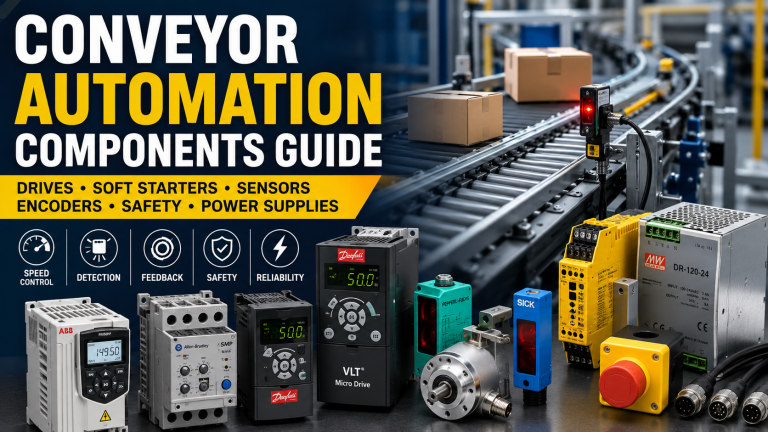
For general-purpose replacement drives, you may want to compare options such as ABB ACS580-01 Inverter Drives, Danfoss VLT AutomationDrives and Schneider ATV320 Inverter Drives.
4. Check the Application Type and Overload Requirement
A fan or pump drive does not usually need the same overload capacity as a conveyor, crusher, mixer, hoist or indexing machine. That is why two drives with the same kilowatt rating may not be suitable for the same job.
For light-duty applications, a standard replacement may be suitable. For heavy-duty applications, you may need a drive with a higher overload rating or a larger frame size.
Light-duty applications usually include:
- Fans
- Pumps
- HVAC systems
- Simple speed control
Heavy-duty applications may include:
- Conveyors
- Mixers
- Extruders
- Crushers
- Lifting or hoisting systems
- High-starting-torque machinery
For demanding industrial applications, consider stronger drive ranges such as ABB ACS880-01 Inverter Drives, Allen Bradley PowerFlex 755 Inverters or Siemens SINAMICS G120C Inverter Drives.
5. Match the Control Method
The next key check is how the existing inverter drive is controlled. Some drives are operated directly from the keypad, while others are controlled by external switches, potentiometers, PLC signals, analogue references or communication networks.
If the replacement drive does not support the same control method, the wiring and programming may need to be changed.
Common control methods include:
- Keypad control: Start, stop and speed set directly on the drive
- Digital inputs: External start, stop, forward, reverse or preset speed signals
- Analogue input: 0–10V or 4–20mA speed reference
- Relay outputs: Fault, run or status signals back to the panel
- Fieldbus communication: Profibus, Profinet, EtherNet/IP, Modbus, CANopen or similar
Before removing the old drive, take clear photos of the terminal wiring and record the parameter settings where possible. This makes the replacement setup much easier and reduces downtime.
6. Check Communication Compatibility
If the obsolete inverter drive communicates with a PLC, HMI or building management system, communication compatibility becomes one of the most important replacement checks. A drive that matches the power rating may still be wrong if it cannot communicate with the existing control system.
Check whether the old drive uses:
- Modbus RTU
- Modbus TCP
- Profibus
- Profinet
- EtherNet/IP
- CANopen
- DeviceNet
- BACnet
If the original system uses plug-in communication cards, you may need a replacement drive that supports the same option module or an equivalent communication interface. For systems built around Allen Bradley equipment, our Allen Bradley Modules category may also be useful when checking compatible automation hardware.
7. Match the Enclosure Rating and Installation Environment
The replacement drive must be suitable for where it is installed. A drive fitted inside a clean electrical panel may only need an IP20 rating. A drive mounted directly on a machine, in a dusty area or near washdown zones may need a higher protection rating.
Common enclosure considerations include:
- IP20: Usually for panel-mounted drives
- IP54: Better protection against dust and splashing water
- IP55/IP66: Suitable for harsher industrial environments depending on the model
- Ambient temperature: Check the drive’s operating temperature range
- Ventilation: Make sure the panel has enough airflow
- Contamination: Consider dust, moisture, oil mist and chemical exposure
If the old drive failed because of heat, dust or moisture, replacing it with the same style of drive may not solve the root problem. You may need improved ventilation, a higher IP-rated drive, better panel filtration or a larger enclosure.
8. Check the Physical Size and Mounting Space
Modern inverter drives are often smaller than older models, but this is not always guaranteed. Before ordering a replacement, check the available panel space, mounting hole positions, cable access and ventilation clearance.
Measure the existing drive and compare:
- Height
- Width
- Depth
- Mounting hole spacing
- Top and bottom clearance
- Side clearance
- Cable entry position
If the new drive is larger, you may need to modify the panel. If it is smaller, you may need a mounting plate or adaptor arrangement. Always leave enough clearance for heat dissipation, especially on higher-power drives.
9. Check Braking Requirements
Some machines need dynamic braking to stop quickly or control overhauling loads. This is common on conveyors, centrifuges, unwinders, hoists, saws and machines with high inertia.
If the old drive uses a braking resistor, the replacement drive must either have a built-in brake chopper or support an external braking unit. You also need to check that the braking resistor is correctly rated for the new drive.
Important braking checks include:
- Does the existing drive use a braking resistor?
- Does the replacement drive include a brake chopper?
- Is the resistor resistance value suitable?
- Is the resistor power rating suitable?
- How often does the machine stop or decelerate?
- Does the load regenerate energy back into the drive?
If your machine needs controlled deceleration, browse our Braking Resistors category when planning the replacement.
10. Check EMC Filters, Line Reactors and Cable Requirements
Older inverter drive installations may include external filters, line reactors, output chokes or screened motor cables. These components help protect the drive, reduce electrical noise and improve system reliability.
When replacing an obsolete drive, do not ignore the surrounding components. A new drive may have a built-in EMC filter, but the installation may still require additional filtering depending on the cable length, supply quality and electrical environment.
Check for:
- Input EMC filters
- Line reactors
- Output reactors or motor chokes
- Screened motor cable
- Correct earthing and shielding
- Long motor cable runs
- Nearby sensitive control equipment
For replacement installations, you can also review our Filters, Siemens Line Reactors and Cables categories to check supporting components.
11. Save the Old Drive Parameters Before Replacement
If the old inverter drive still powers up, try to record or download the parameters before removing it. Even if the exact replacement is no longer available, the old parameter set gives you valuable information about motor data, acceleration time, deceleration time, control mode, input settings, output settings and fault behaviour.
Key parameters to record include:
- Motor rated voltage
- Motor rated current
- Motor rated frequency
- Motor rated speed
- Acceleration time
- Deceleration time
- Minimum and maximum frequency
- Control source
- Speed reference source
- Digital input functions
- Analogue input scaling
- Relay output functions
- Fault reset behaviour
If the old drive is completely dead, take photos of the wiring, nameplate and connected components. The more information you can collect, the easier it is to specify a correct replacement.
12. Decide Whether to Replace Like-for-Like or Upgrade
Sometimes the best option is a direct modern equivalent. Other times, replacing an obsolete inverter drive is a good opportunity to upgrade the machine. A newer drive may offer better energy efficiency, improved motor control, easier programming, built-in safety functions, improved communications and better diagnostics.
However, upgrading should still be done carefully. A more advanced drive is only useful if it suits the machine, control system and maintenance team.
A like-for-like replacement is usually best when:
- The machine is simple
- The existing control wiring must stay the same
- Downtime must be kept to a minimum
- The original drive function was already suitable
- You want the easiest possible changeover
An upgrade may be better when:
- The old drive is unreliable or difficult to source
- The machine needs better speed control
- You want improved communication with a PLC
- You need better diagnostics or fault history
- The application has changed since the original drive was fitted
Obsolete Inverter Drive Replacement Checklist
Before ordering a replacement inverter drive, use this checklist to make sure the key specifications are covered:
- Input supply voltage and phase: Must match the machine supply
- Output voltage: Must suit the motor wiring and nameplate
- Motor power: Match the kW or HP rating as a starting point
- Output current: Must meet or exceed the motor full load current
- Overload rating: Must suit light-duty or heavy-duty application demands
- Control method: Keypad, terminals, analogue signal or fieldbus
- Communication: Must suit the PLC or control network if required
- Enclosure rating: Must suit the installation environment
- Physical size: Must fit inside the panel or machine space
- Braking: Check braking resistor and brake chopper requirements
- EMC and reactors: Check filters, line reactors and cable length
- Parameters: Record old settings before removal where possible
Best Replacement Inverter Drive Categories to Check
If you are replacing an obsolete drive, these product categories are good starting points depending on the original brand, application and control requirements:
- ABB ACS580-01 Inverter Drives – strong general-purpose replacement option for pumps, fans, conveyors and industrial machinery.
- ABB ACS880-01 Inverter Drives – suitable for more demanding industrial applications and heavier-duty control.
- Allen Bradley PowerFlex 755 Inverters – useful for Allen Bradley-based control systems and higher-performance installations.
- Danfoss VLT AutomationDrives – strong option for automation, process control and industrial motor applications.
- Danfoss VLT Micro Drive – compact replacement option for smaller motors and simpler speed control applications.
- Schneider ATV320 Inverter Drives – compact machine drive option for OEM equipment and general automation.
- Siemens SINAMICS G120C Inverter Drives – useful for Siemens-based installations and modern machine control systems.
- Braking Resistors – required when the application needs fast stopping or controlled deceleration.
- Filters – useful for reducing electrical noise and supporting reliable inverter drive installations.
- Cables – suitable for replacement installations where motor cabling, control wiring or screened cable may also need updating.
Final Thoughts: Matching the Right Specs Prevents Costly Downtime
Replacing an obsolete inverter drive is not just about finding a drive with the same kilowatt rating. The safest approach is to match the complete specification: supply voltage, motor voltage, output current, overload rating, control method, communication, braking, enclosure rating and installation environment.
If the replacement is selected correctly, the machine can often be brought back into service quickly without needing a direct like-for-like obsolete part. In many cases, a modern replacement drive can also improve reliability, diagnostics, control performance and long-term availability.
At Drive Outlet Megastore, we supply a wide range of inverter drives, braking resistors, filters, cables, modules and automation components to help replace obsolete industrial drives quickly and cost-effectively. Whether you are replacing an ABB, Allen Bradley, Danfoss, Schneider, Siemens or other industrial drive, matching the right specifications first is the key to avoiding unnecessary downtime.