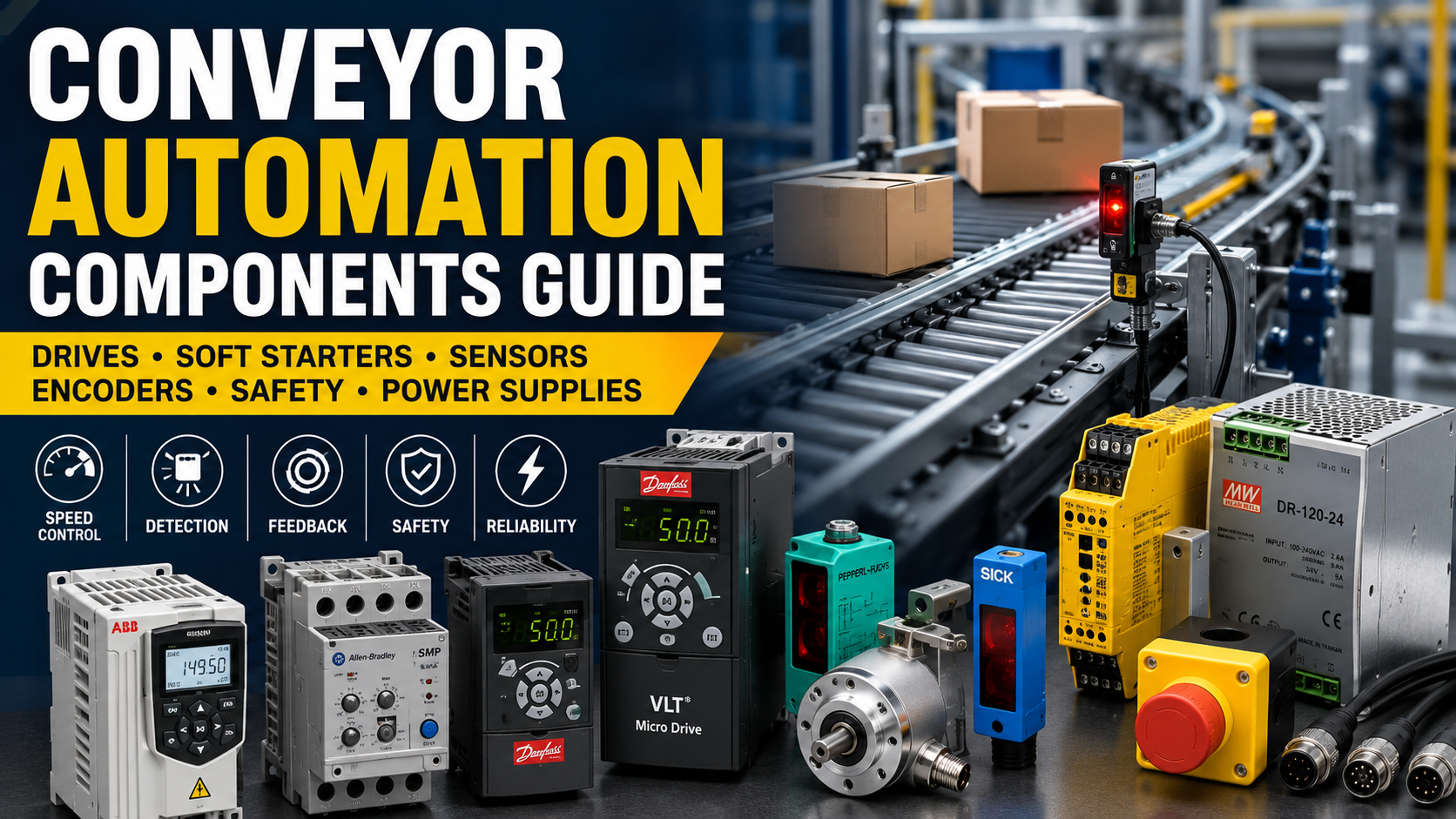
Conveyor Automation Components Guide: Drives, Soft Starters, Sensors, Encoders and Safety Parts Explained
Conveyor systems are used across manufacturing, packaging, warehousing, food processing, logistics and industrial production lines. To keep a conveyor running reliably, the correct automation components are essential. A complete conveyor control system may include inverter drives, soft starters, sensors, encoders, safety relays, light curtains, PLC modules, power supplies and industrial cables.
This guide explains the main conveyor automation components, what each part does, and how to choose the right equipment for motor control, product detection, safety guarding and machine reliability.
At Drive Outlet Megastore, we supply a wide range of industrial automation parts including Inverter Drives, Soft Starts, Sensors, Encoders, Safety Relays and Power Supplies for conveyor control panels and industrial machinery.
What Components Are Used in Conveyor Automation?
A conveyor automation system is usually built from several connected electrical and control components. The exact parts depend on the conveyor type, motor size, speed requirements, product detection needs and safety standards.
The most common conveyor automation components include:
- Inverter drives: Used to control conveyor motor speed, acceleration and deceleration.
- Soft starters: Used for smooth fixed-speed motor starting where variable speed control is not needed.
- Photoelectric sensors: Used to detect products, boxes, pallets or gaps on the conveyor.
- Encoders: Used for speed feedback, position tracking and synchronisation.
- Safety relays: Used for emergency stop circuits, guard switches and safety devices.
- Safety light curtains: Used to protect operators around dangerous moving machinery.
- PLC modules: Used for logic control, inputs, outputs and communication.
- Power supplies: Used to provide stable 24V DC power to sensors, relays and control circuits.
- Cables: Used to connect drives, sensors, encoders, motors and control panels.
Inverter Drives for Conveyor Speed Control
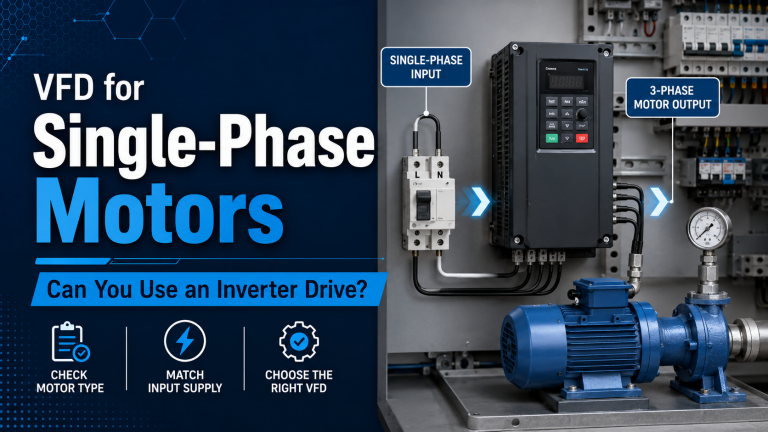
An inverter drive, also known as a VFD or variable frequency drive, is one of the most important components in a conveyor automation system. It controls the speed of the conveyor motor by adjusting the frequency and voltage supplied to the motor.
Using an inverter drive allows the conveyor to start smoothly, stop smoothly, change speed, reduce mechanical shock and improve process control. This is especially useful on packaging lines, sorting systems, production conveyors and material handling equipment.
Conveyor applications often use inverter drives when the system needs:
- Adjustable conveyor speed
- Controlled acceleration and deceleration
- Smoother start-up to protect belts and gearboxes
- Reduced product movement or tipping during start-up
- Multiple conveyor zones running at different speeds
- PLC control through digital, analogue or fieldbus signals
Popular conveyor drive ranges include Allen Bradley PowerFlex 525 Inverters, ABB ACS355-01E Inverter Drives, Danfoss VLT Micro Drive and Siemens SINAMICS G120C Inverter Drives.
When to Use a Soft Starter on a Conveyor
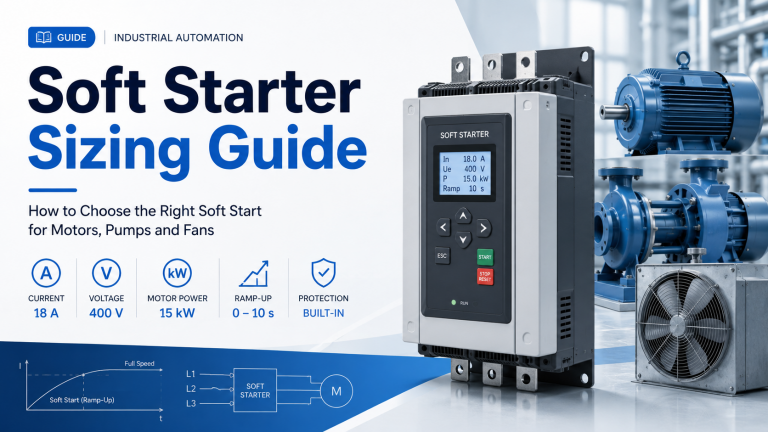
A soft starter is used when a conveyor motor only needs smooth starting and stopping, not variable speed control. Instead of instantly applying full voltage to the motor, the soft starter gradually ramps the motor up to full speed.
This can reduce electrical inrush current and limit mechanical shock on belts, rollers, couplings and gearboxes. Soft starters are often a good choice for fixed-speed conveyors where the motor runs at one speed once started.
A soft start may be suitable for a conveyor when:
- The conveyor runs at a fixed speed
- The main issue is harsh starting or mechanical shock
- The application does not need speed adjustment
- The control panel needs a simpler alternative to a VFD
- The motor only starts and stops a limited number of times per hour
Drive Outlet Megastore supplies ABB Soft Starts, Allen Bradley Soft Starts and Danfoss Soft Starts for industrial motor starting applications.
Sensors for Product Detection on Conveyors
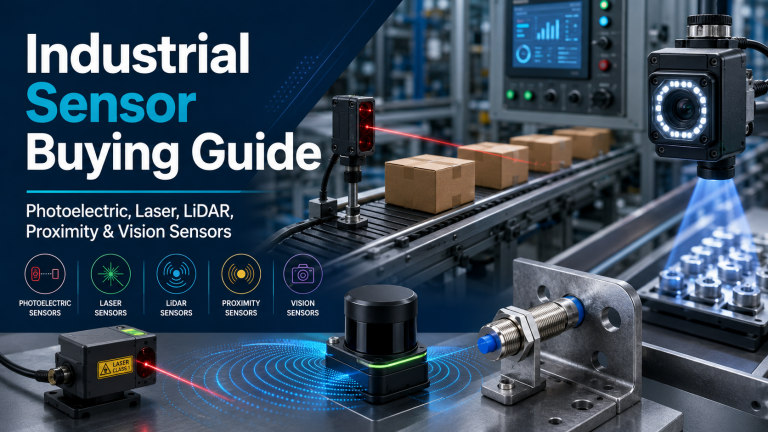
Sensors are essential for conveyor automation because they detect the presence, absence, position or movement of products. Without reliable sensors, automated conveyor systems cannot correctly count products, control spacing, reject faulty items or trigger downstream processes.
Industrial sensors are commonly used on conveyors for:
- Product detection
- Box and pallet detection
- Counting items on a line
- Detecting gaps between products
- Triggering labelling or scanning equipment
- Checking product position before transfer
- Detecting jams or blockages
Photoelectric Sensors are especially common on conveyor systems because they can detect objects without physical contact. They are used across packaging lines, logistics systems, bottling lines, food production and automated handling equipment.
Other conveyor sensing options may include proximity sensors, laser sensors, LiDAR sensors, code readers, cameras and flow or process sensors depending on the application.
Encoders for Conveyor Speed and Position Feedback
An encoder is used to provide speed, position or movement feedback from a motor, roller, shaft or conveyor mechanism. In conveyor automation, encoders are often used when the control system needs to know exactly how far the conveyor has moved or how fast it is running.
Encoders are useful for:
- Speed feedback to drives or PLC systems
- Position tracking on indexing conveyors
- Synchronising multiple conveyor sections
- Measuring belt movement
- Triggering cutting, printing, scanning or labelling processes
- Detecting belt slip or motion faults
For simple conveyors, an encoder may not be required. However, for higher accuracy systems such as packaging machines, automated sorting conveyors, positioning conveyors and synchronised production lines, encoder feedback can be extremely important.
PLC Modules and Conveyor Control Logic
PLC systems are used to control the logic of a conveyor automation system. The PLC reads signals from sensors, encoders, emergency stops and operator controls, then sends outputs to drives, contactors, relays, lamps, valves and other control devices.
Typical PLC functions in conveyor automation include:
- Starting and stopping conveyors
- Controlling multiple conveyor zones
- Reading sensor inputs
- Sending speed references to inverter drives
- Monitoring faults and alarms
- Managing emergency stop and reset logic
- Communicating with HMIs, scanners and higher-level systems
Drive Outlet Megastore supplies a wide range of industrial modules including Allen Bradley Modules, Siemens Simatic S7-1200 Modules and Omron Modules for automation panels, machine control and conveyor systems.
Safety Relays and Light Curtains for Conveyor Safety
Conveyor systems contain moving belts, rollers, chains, motors and mechanical drive parts, so safety components are critical. Safety devices help protect operators, maintenance engineers and nearby personnel from dangerous machine movement.
Safety Relays are commonly used to monitor emergency stop buttons, guard switches, safety gates and other safety input devices. If a safety circuit is opened, the safety relay can remove power from the relevant machinery control circuit.
Safety Light Curtain Senders are used where physical guarding is not practical or where operators need regular access to a machine area. They create a detection field that can stop the machine if the light beam is interrupted.
Conveyor safety systems may include:
- Emergency stop buttons
- Pull-cord switches
- Guard door switches
- Safety relays
- Safety light curtains
- Safety controllers
- Motor contactors or safe torque off circuits
Power Supplies for Conveyor Control Panels
Most conveyor control panels use 24V DC control circuits. A reliable industrial power supply is needed to run sensors, relays, PLC modules, safety devices, signal lamps, interface modules and other control components.
Power supply selection should consider:
- Input voltage
- Output voltage
- Current rating
- Panel temperature
- Reserve capacity
- Short-circuit protection
- Redundancy requirements
Undersized or poor-quality power supplies can cause intermittent faults, sensor dropouts and control circuit instability. For conveyor systems that run continuously, choosing a reliable industrial power supply is important.
Cables and Connectivity for Conveyor Systems
Industrial conveyor systems rely on correct cabling. Drives, motors, encoders, sensors, safety circuits and PLC modules all need suitable cables for reliable operation.
Cables used in conveyor automation may include:
- Motor cables
- Screened VFD cables
- Sensor cables
- Encoder cables
- Communication cables
- Power supply wiring
- Safety circuit wiring
Correct cable selection helps reduce electrical noise, signal loss, intermittent faults and EMC issues. This is especially important when inverter drives, encoders and sensors are installed close together in the same machine or control panel.
Recommended Spare Parts for Conveyor Systems
Conveyor downtime can be expensive, especially in production, logistics and packaging environments. Keeping critical spare parts in stock can help reduce downtime when a component fails.
Common conveyor spare parts include:
- Inverter drives for main conveyor motors
- Soft starters for fixed-speed motor starters
- Photoelectric sensors for product detection
- Encoders for speed or position feedback
- Safety relays for emergency stop circuits
- Power supplies for 24V DC control circuits
- PLC input and output modules
- Replacement industrial cables
- Circuit breakers, contactors and control relays
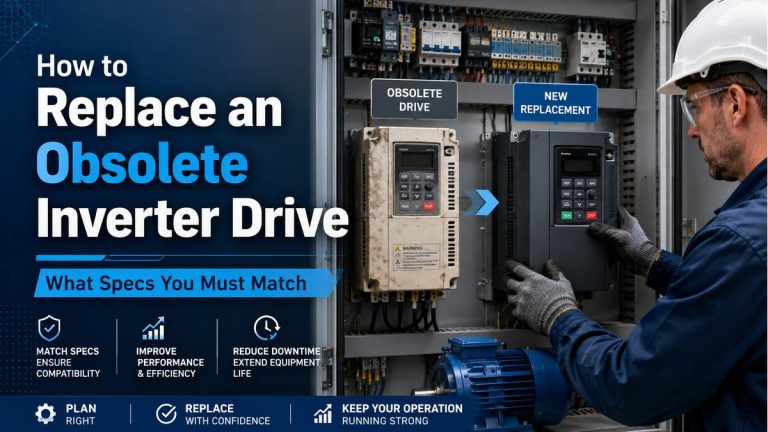
For older machinery, it is also worth identifying obsolete drives, discontinued PLC modules and hard-to-source sensors before they fail. Having replacement part numbers ready can reduce emergency downtime.
How to Choose the Right Conveyor Automation Components
When choosing automation parts for a conveyor system, start by looking at the motor, application and control requirements. The right components depend on how the conveyor operates, how often it starts, what it carries and how it connects to the wider machine.
1. Check the Motor Size and Voltage
For drives and soft starters, always check the motor kW, full load current, supply voltage and phase. Motor current is especially important when selecting an inverter drive or soft starter.
2. Decide Whether You Need Variable Speed
If the conveyor needs adjustable speed, use an inverter drive. If it only needs smooth starting and stopping at fixed speed, a soft starter may be enough.
3. Identify Product Detection Points
Work out where sensors are needed for product detection, counting, spacing, jam detection and process control.
4. Check Feedback Requirements
If the conveyor needs accurate speed or position feedback, consider an encoder. This is especially useful for indexing, synchronising or high-accuracy conveyor systems.
5. Review Safety Requirements
Check where emergency stops, guard switches, safety relays and light curtains are required. Safety components should be selected carefully based on the machine risk assessment.
6. Check Panel Power and Wiring
Make sure the control panel has correctly sized power supplies, protection devices and cables. Poor panel design can cause faults even when the main automation components are correct.
Shop Conveyor Automation Components
Use the links below to browse conveyor automation parts and related industrial control categories at Drive Outlet Megastore:
- Inverter Drives
- Allen Bradley PowerFlex 525 Inverters
- ABB ACS355-01E Inverter Drives
- Danfoss VLT Micro Drive
- Siemens SINAMICS G120C Inverter Drives
- Soft Starts
- ABB Soft Starts
- Allen Bradley Soft Starts
- Encoders
- Sensors
- Photoelectric Sensors
- Safety Relays
- Safety Light Curtain Senders
- Power Supplies
- Cables
Conveyor Automation FAQs
What is the most important component in a conveyor control system?
The most important component depends on the conveyor design. For motor speed control, the inverter drive is usually the key component. For product detection, sensors are essential. For safety, safety relays, emergency stops and guarding devices are critical.
Should I use an inverter drive or soft starter on a conveyor?
Use an inverter drive if the conveyor needs variable speed, controlled acceleration, speed matching or PLC speed control. Use a soft starter if the conveyor only needs smooth starting and stopping at fixed speed.
Why are photoelectric sensors used on conveyors?
Photoelectric sensors detect products without physical contact. They are commonly used for counting, positioning, spacing, jam detection and triggering other automation equipment.
When does a conveyor need an encoder?
A conveyor may need an encoder when the system requires accurate speed feedback, position tracking, indexing, synchronisation or belt movement monitoring.
What safety parts are used on conveyors?
Common conveyor safety components include emergency stops, pull-cord switches, guard switches, safety relays, safety light curtains and safety controllers.
What voltage do conveyor sensors usually use?
Many industrial conveyor sensors use 24V DC, which is normally supplied from an industrial control panel power supply.
Need Conveyor Automation Parts?
Drive Outlet Megastore supplies industrial automation components for conveyor systems, motor control panels, production lines, packaging machinery and factory automation. Whether you need replacement inverter drives, soft starters, sensors, encoders, safety relays, power supplies or cables, we can help source the right part for your application.
Browse our conveyor automation categories online or search by part number to find industrial automation products from ABB, Allen Bradley, Danfoss, Siemens, Schneider, Omron, SICK, IFM, Pepperl+Fuchs and more.