Encoder Selection Guide: Incremental vs Absolute Encoders Explained
Encoders are used in industrial automation systems to measure speed, position, direction and movement. They are commonly fitted to motors, conveyors, servo systems, packaging machines, printing machinery, lifting systems and production equipment where accurate feedback is required.
Choosing the right encoder is important because the wrong type can cause speed feedback issues, positioning errors, drive faults, PLC input problems or machine downtime. This encoder selection guide explains the difference between incremental and absolute encoders, where each type is used, and what to check before ordering a replacement encoder.
At Drive Outlet Megastore, we supply a wide range of Encoders, Servo Drives, Servo Motors, Inverter Drives, PLC modules, sensor modules and industrial automation parts for motion control, speed feedback and machine control systems.
What Is an Encoder?
An encoder is a feedback device that converts mechanical movement into an electrical signal. That signal can then be read by a PLC, inverter drive, servo drive, motion controller or control system.
Encoders are normally used to measure:
- Motor speed
- Shaft position
- Rotational direction
- Conveyor movement
- Linear travel
- Indexing position
- Servo motor feedback
- Belt slip or machine movement
In simple terms, an encoder tells the control system how fast something is moving, where it is, or how far it has travelled.
Incremental vs Absolute Encoders: What Is the Difference?
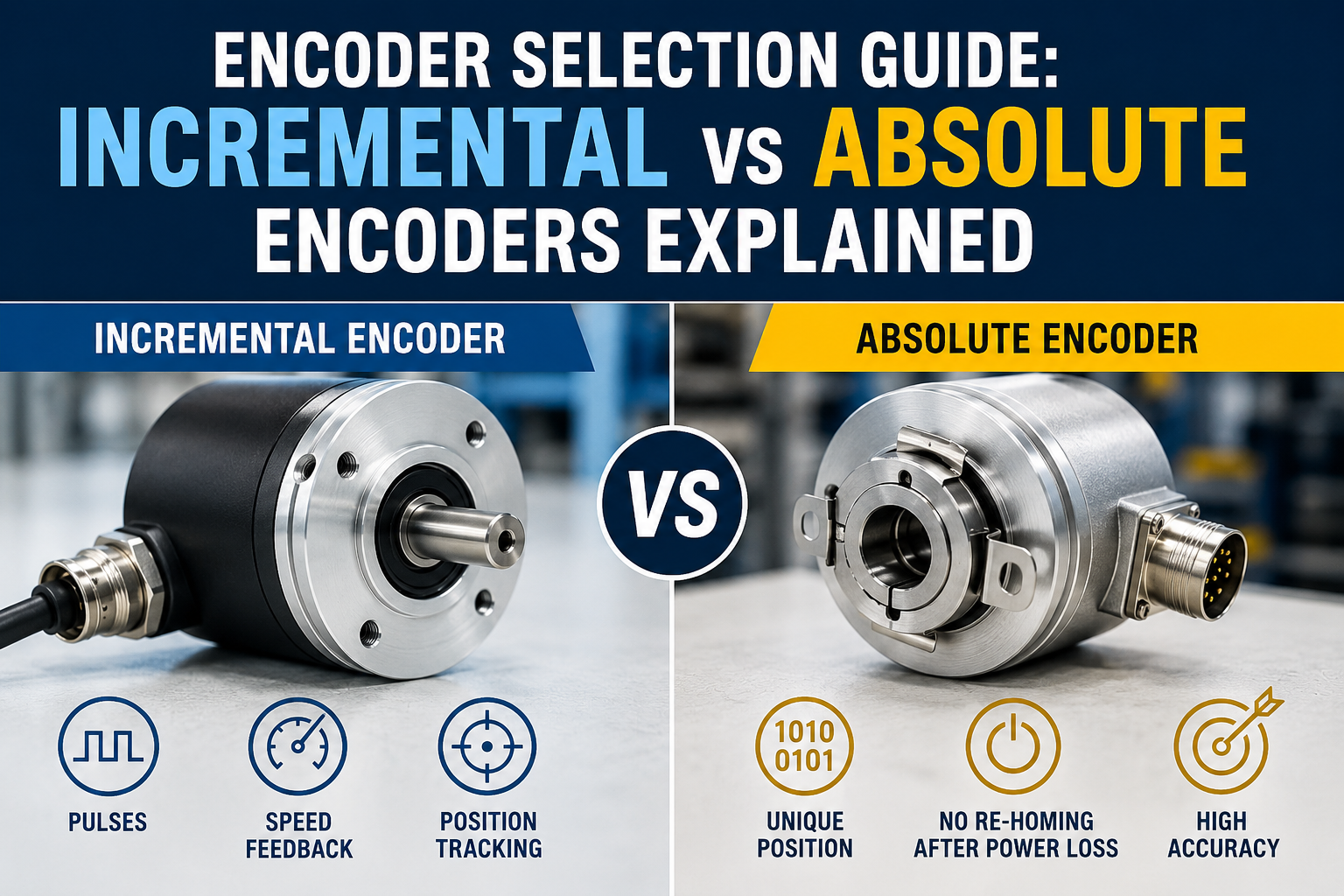
The two main encoder types are incremental encoders and absolute encoders. Both are used for motion feedback, but they work in different ways.
An incremental encoder produces pulses as the shaft rotates. The control system counts these pulses to calculate speed, direction and movement. An absolute encoder provides a unique position value, so the control system can know the exact position even after power is removed and restored.
The best option depends on whether the machine only needs movement feedback or whether it needs to know the exact position at all times.
Incremental Encoders Explained
An incremental encoder generates a series of pulses as it rotates. The number of pulses per revolution, often called PPR, determines the resolution of the encoder. The PLC, drive or controller counts these pulses to measure speed, direction and distance travelled.
Incremental encoders are commonly used because they are simple, cost-effective and suitable for many industrial speed and motion feedback applications.
Where Incremental Encoders Are Used
- Conveyor speed feedback
- Motor speed monitoring
- Inverter drive feedback
- Basic positioning systems
- Printing and packaging machines
- Length measurement systems
- Cut-to-length machinery
- Belt movement monitoring
Advantages of Incremental Encoders
- Simple and widely used
- Good for speed feedback
- Often lower cost than absolute encoders
- Available in many sizes and pulse counts
- Suitable for many PLC and drive systems
Limitations of Incremental Encoders
- The system may need to re-home after power loss
- Position is based on counted pulses, not a stored absolute value
- Missed pulses can cause position errors
- Wiring and signal quality are important
Incremental encoders are a strong choice when the system mainly needs speed feedback, movement counting or relative position tracking.
Absolute Encoders Explained
An absolute encoder provides a unique position value for every shaft position. This means the controller can know the exact position immediately, even after the machine has been switched off and turned back on.
Absolute encoders are often used in applications where losing position would be a problem. They are common in servo systems, robotics, indexing machines, cranes, lifts, packaging machines and high-accuracy motion control systems.
Where Absolute Encoders Are Used
- Servo motor feedback
- Robotic positioning
- Indexing tables
- Crane and lifting systems
- Machine tool positioning
- Automated storage systems
- Packaging and filling machines
- Applications where position must be retained after power loss
Advantages of Absolute Encoders
- Provides exact position feedback
- Does not normally need homing after power loss
- Better for accurate positioning applications
- Useful for servo and motion control systems
- Can support advanced communication protocols
Limitations of Absolute Encoders
- Usually more expensive than incremental encoders
- May require specific communication compatibility
- Replacement selection can be more complex
- Protocol, resolution and wiring must be matched carefully
Absolute encoders are the better choice when the machine needs exact position feedback and cannot afford to lose position after a power cycle.
Single-Turn vs Multi-Turn Absolute Encoders
Absolute encoders can be single-turn or multi-turn.
A single-turn absolute encoder measures the position within one revolution of the shaft. Once the shaft completes one full turn, the position value repeats.
A multi-turn absolute encoder measures both the position within one revolution and the number of complete revolutions. This is useful where the machine needs to track a long movement, such as a lift, hoist, linear axis, automated storage system or long travel mechanism.
Use a Single-Turn Absolute Encoder When:
- The shaft only needs position feedback within one revolution
- The application uses rotary indexing
- The system only needs angular position
Use a Multi-Turn Absolute Encoder When:
- The machine needs to track multiple shaft revolutions
- The encoder is linked to a linear movement
- The system must remember total travel after power loss
- The application involves lifting, travel or long positioning movement
Encoder Resolution Explained
Encoder resolution tells you how much detail the encoder can measure. For incremental encoders, this is usually shown as pulses per revolution, or PPR. For absolute encoders, it may be shown as bits or counts per revolution.
A higher resolution encoder gives more feedback points per revolution. This can improve positioning accuracy, but it also means the controller or drive must be able to process the signal correctly.
Common Encoder Resolution Checks
- Pulse count or PPR
- Counts per revolution
- Single-turn resolution
- Multi-turn resolution
- Maximum speed at selected resolution
- PLC or drive input frequency limit
When replacing an encoder, do not assume that a higher resolution is always better. The replacement must match the control system, drive input and application requirements.
Encoder Output Signals Explained
Encoder output type is one of the most important details to check before ordering a replacement. If the output signal does not match the PLC, drive or controller, the encoder may not work correctly.
Common Incremental Encoder Output Types
- HTL: Often used with industrial PLC and drive systems.
- TTL: Used where lower voltage differential signals are required.
- Push-pull: Common on many general-purpose incremental encoders.
- Open collector: Used in some older or simple control systems.
- Line driver: Used for reliable signal transmission and higher-speed applications.
Common Absolute Encoder Communication Types
- SSI
- CANopen
- Profibus
- Profinet
- EtherCAT
- DeviceNet
- Ethernet/IP
Always check the existing encoder label, wiring diagram, drive manual or PLC input module before selecting a replacement.
Encoders for VFD Speed Feedback
Encoders are often used with inverter drives where closed-loop speed feedback is required. A standard VFD can control motor speed without an encoder in many applications, but encoder feedback can improve speed holding, low-speed performance and control accuracy.
Encoder feedback may be useful for:
- Hoists and lifting systems
- Conveyors requiring accurate speed control
- Extruders
- Printing machines
- Winders and unwinders
- Applications with changing load conditions
- Low-speed torque applications
For demanding motor control applications, encoder feedback may be used with advanced inverter drives such as Allen Bradley PowerFlex 753 Inverters, Allen Bradley PowerFlex 755 Inverters, ABB ACS880-01 Inverter Drives and Siemens SINAMICS G120C Inverter Drives.
Encoders for Servo Drives and Servo Motors
Servo systems rely on accurate feedback. A servo motor normally uses an encoder or resolver so the servo drive can control position, speed and torque accurately.
In servo applications, the encoder is not just an optional accessory. It is a critical part of the control loop. If the encoder signal is wrong, damaged or incompatible, the servo drive may fault or the motor may not position correctly.
Encoder feedback is commonly used with Servo Drives and Servo Motors in applications such as:
- Robotics
- Packaging machines
- Pick-and-place systems
- CNC machinery
- Labelling machines
- Printing machinery
- Indexing tables
- Automated assembly systems
When replacing an encoder on a servo motor, always check the motor model, drive model, feedback protocol and cable connection before ordering.
How Encoders Connect to PLCs and Control Systems
Encoders can connect directly to PLC high-speed counter inputs, encoder interface modules, drive feedback cards, servo drives or motion control systems. The correct connection depends on the encoder type and the control system.
PLC-based encoder systems may use specialist modules such as high-speed counter cards, positioning modules or communication modules. Drive-based systems may use encoder option cards or dedicated feedback inputs.
Drive Outlet Megastore supplies automation modules including Allen Bradley Modules, Siemens Simatic S7-1500 Modules, Siemens Sinamics S120 Modules, Sinamics SMC30 Sensor Modules and Omron Modules for industrial control and motion applications.
Encoder Mechanical Mounting Options
The mechanical style of the encoder must match the motor or machine shaft. Even if the electrical specification is correct, the encoder will not fit if the shaft, flange or mounting style is wrong.
Common Encoder Mounting Types
- Solid shaft encoder: Uses a protruding shaft and is normally connected with a coupling.
- Hollow shaft encoder: Fits directly over the machine shaft.
- Blind hollow shaft encoder: Fits over the end of a shaft and is often used on motors.
- Through hollow shaft encoder: Allows the shaft to pass through the encoder body.
- Flange mount encoder: Uses a mounting flange for direct machine installation.
Mechanical Details to Check
- Shaft diameter
- Shaft length
- Mounting flange
- Bolt hole pattern
- Encoder body diameter
- Connector direction
- Available installation space
Encoder Cables and Connectors
Encoder signals can be sensitive to electrical noise, especially in panels with inverter drives, servo drives, contactors and motor cables. Correct cable selection is important for reliable feedback.
Many encoder faults are caused by damaged cables, poor screening, incorrect wiring, loose connectors or electrical interference. For replacement work, always check the connector type, pinout, cable length and shielding.
Drive Outlet Megastore supplies Cables for industrial automation systems, including sensor cables, encoder cables, drive cables and control panel wiring products.
Encoder Cable Checks
- Connector type
- Pin configuration
- Cable length
- Screening and shielding
- Voltage rating
- Flex rating for moving applications
- Environmental protection
How to Choose the Right Encoder
When choosing an encoder, start with the application. The correct encoder depends on whether you need speed feedback, position feedback, retained position, high accuracy or simple movement counting.
1. Decide Whether You Need Incremental or Absolute Feedback
Use an incremental encoder for speed feedback, movement counting and general-purpose machine feedback. Use an absolute encoder when the system must know the exact position after power loss.
2. Check the Resolution
Match the encoder resolution to the application and control system. Too low may reduce accuracy, while too high may exceed the input frequency capability of the PLC or drive.
3. Confirm the Output Signal
Check whether the system needs HTL, TTL, push-pull, line driver, SSI, fieldbus or Ethernet-based feedback. Output compatibility is critical.
4. Match the Supply Voltage
Encoders may use different supply voltages such as 5V DC, 10-30V DC or specific servo feedback supplies. Always check the required voltage before ordering.
5. Check Mechanical Fit
Confirm shaft type, shaft diameter, mounting style, flange size, body size and connector position.
6. Check Environmental Requirements
Consider dust, oil, vibration, moisture, temperature and washdown conditions. Choose the correct IP rating and housing design for the environment.
7. Check Cable and Connector Compatibility
Make sure the replacement encoder uses the correct connector, pinout and cable type. A physically similar encoder may not be electrically compatible.
Common Encoder Buying Mistakes
Choosing by Appearance Only
Two encoders can look almost identical but have completely different output signals, resolutions, supply voltages or communication protocols.
Ignoring the Output Type
An HTL encoder cannot always be replaced with a TTL encoder, and an SSI absolute encoder cannot simply be swapped for a different fieldbus encoder unless the control system supports it.
Using the Wrong Resolution
A different pulse count or resolution can affect speed scaling, positioning accuracy and PLC logic.
Not Checking the Shaft or Mounting Style
A replacement encoder must physically fit the machine. Shaft size, mounting flange and connector orientation all matter.
Forgetting the Cable
Damaged encoder cables are a common cause of feedback faults. Sometimes the encoder is not the only part that needs replacing.
Shop Encoders and Motion Control Components
Use the links below to browse encoder, motion control and automation categories at Drive Outlet Megastore:
- Encoders
- Servo Drives
- Servo Motors
- Inverter Drives
- Allen Bradley PowerFlex 753 Inverters
- Allen Bradley PowerFlex 755 Inverters
- ABB ACS880-01 Inverter Drives
- Siemens SINAMICS G120C Inverter Drives
- Siemens Sinamics S120 Modules
- Sinamics SMC30 Sensor Modules
- Allen Bradley Modules
- Siemens Simatic S7-1500 Modules
- Omron Modules
- Cables
- Sensors
Encoder Selection FAQs
What is the difference between an incremental and absolute encoder?
An incremental encoder sends pulses that are counted by the control system. An absolute encoder provides a unique position value, allowing the system to know the exact position even after power loss.
Which encoder is best for speed feedback?
Incremental encoders are commonly used for speed feedback because they provide pulse signals that can be used by drives, PLCs and high-speed counter inputs.
Which encoder is best for position feedback?
Absolute encoders are usually better for applications that require exact position feedback, especially where the machine must remember its position after power is removed.
Can I replace an incremental encoder with an absolute encoder?
Not always. The control system must support the encoder output and communication type. Wiring, voltage, resolution and software setup may also need to change.
What does PPR mean on an encoder?
PPR means pulses per revolution. It tells you how many pulses an incremental encoder produces for each full shaft rotation.
Why does my drive need encoder feedback?
Encoder feedback can improve speed accuracy, low-speed performance and closed-loop control. It is often used on conveyors, hoists, winders, extruders and other demanding motor control applications.
Can encoder cable faults cause drive trips?
Yes. Damaged cables, poor screening, loose connectors or electrical noise can cause feedback faults, speed errors and drive trips.
Need Help Finding the Right Encoder?
Drive Outlet Megastore supplies encoders, servo drives, servo motors, inverter drives, PLC modules, sensor modules and industrial cables for automation, motion control and machine feedback applications.
Browse our encoder and automation categories online or search by part number to find replacement parts from leading industrial brands including Allen Bradley, Siemens, ABB, Omron, SICK, IFM, Pepperl+Fuchs, Danfoss and more.